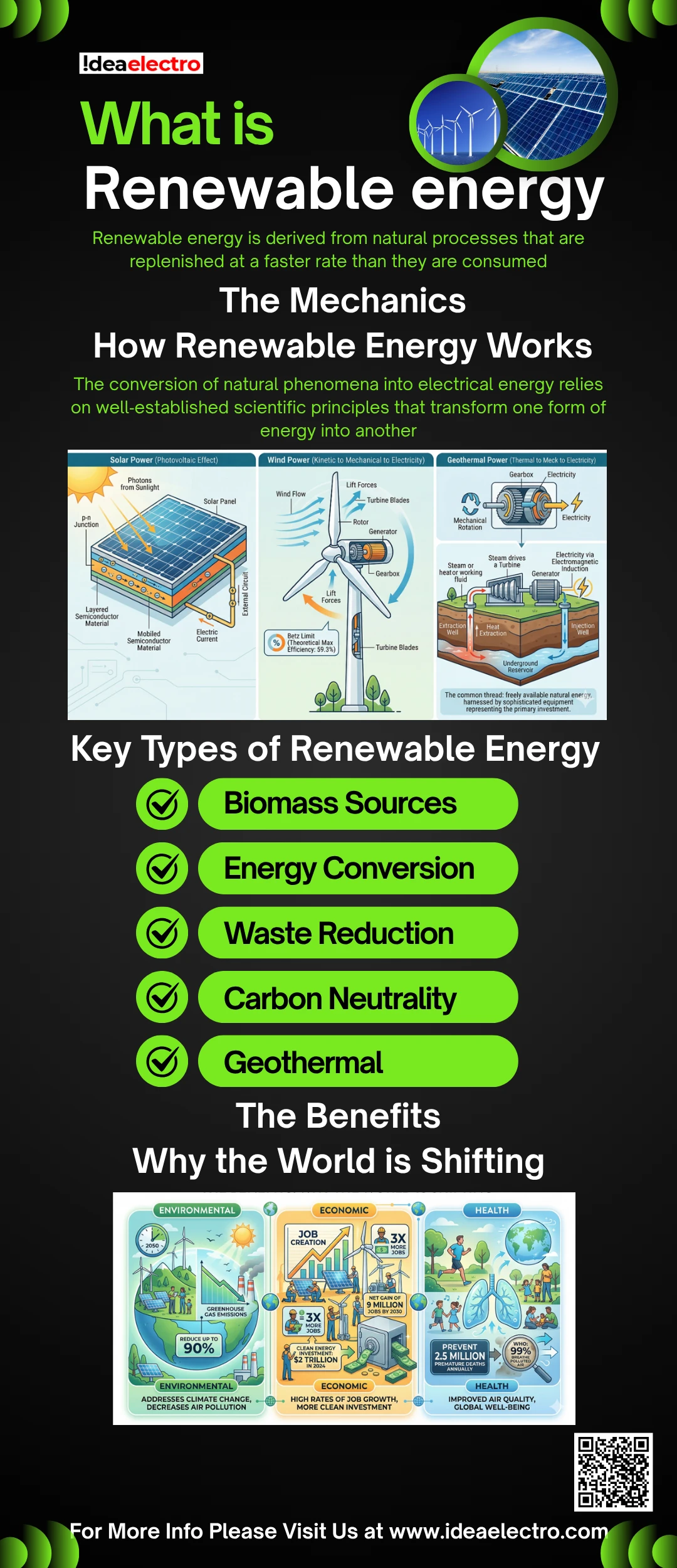
Renewable energy is derived from natural processes that are replenished at a faster rate than they are consumed, in contrast to finite fossil fuels that take millions of years to form. Sources include solar, wind, hydroelectric, geothermal, biomass and ocean energy. While fossil fuels continue to account for over 80 percent of global energy supply, renewable sources are expanding rapidly, reaching 92 EJ of global energy supply in 2023. This shift from finite, polluting fuels to perpetually replenished natural energy forms has become the cornerstone of the modern Green Revolution, offering a practical pathway toward decarbonization and long-term energy security.
The Mechanics: How Renewable Energy Works
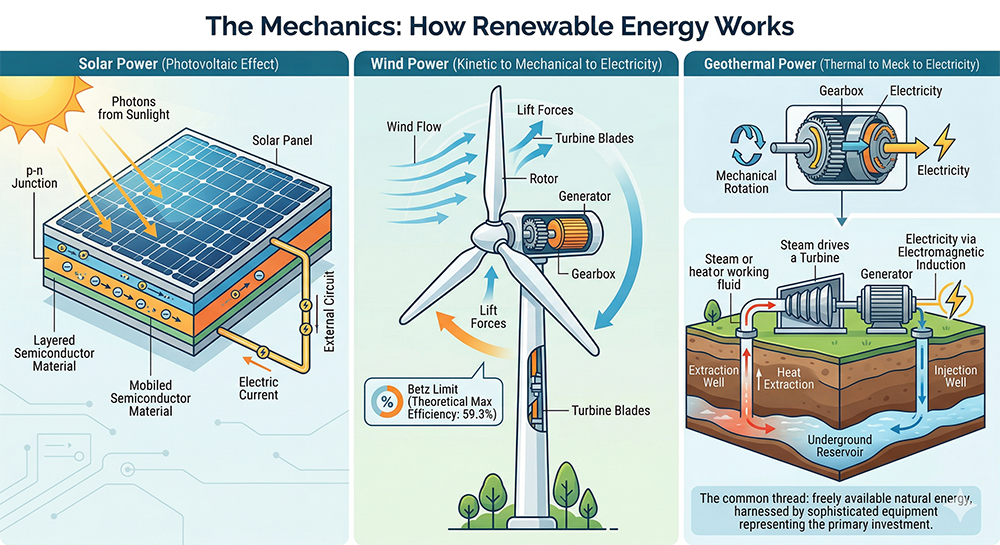
The conversion of natural phenomena into electrical energy relies on well‑established scientific principles that transform one form of energy into another. For solar power, the photovoltaic effect occurs when photon energy from sunlight strikes a p‑n junction within a semiconductor material, causing electrons to move and creating an electric current that can be captured in an external circuit. Wind turbines operate on a different principle: they extract kinetic energy from moving air; as wind flows over turbine blades, the resulting lift forces rotate a rotor connected to a generator, converting mechanical rotation into electricity. The maximum theoretical efficiency for this conversion is the Betz limit of 59.3 percent, meaning that no wind turbine can capture more than approximately 59 percent of the kinetic energy passing through its rotor swept area. For geothermal power, heat extracted from underground reservoirs boils water or another working fluid, producing steam that drives a turbine; the turbine then turns a generator to produce electricity via electromagnetic induction. The common thread across these technologies is that while the natural energy source itself is freely available, the sophisticated equipment required to capture, convert and deliver it as usable electricity represents the primary investment.
Key Types of Renewable Energy Sources
Each renewable energy source has distinct characteristics and geographical preferences, as summarized in the table below.
| Energy Source | Primary Source | Best Geographical Location |
| Solar | Sun’s radiation | High‑insolation regions (deserts, low‑latitude areas) |
| Wind | Atmospheric pressure differences (kinetic energy of air) | Coastal areas, mountain passes, open plains |
| Hydro | Flowing water (potential/kinetic energy of rivers) | Large rivers with consistent flow, mountainous terrain |
| Geothermal | Earth’s internal heat (radioactive decay, residual formation heat) | Volcanic zones, tectonic plate boundaries (e.g., Ring of Fire) |
| Biomass | Organic materials (agricultural residues, forestry waste, energy crops) | Regions with abundant agricultural/forestry activity |
Solar Power harnesses the sun’s rays through photovoltaic panels, which directly convert light into electricity. Global renewable power capacity is expected to double by 2030, with solar PV accounting for almost 80 percent of this increase due to low costs and broad social acceptance.
Wind Power utilizes the kinetic energy of moving air, a phenomenon driven by atmospheric pressure differences. Global wind capacity is projected to nearly double to over 2,000 GW by 2030, though it faces supply chain and permitting challenges in some regions.
Hydropower relies on the reliable energy of flowing water and dams. In 2024, global hydropower generation reached 4,578 TWh, with installed capacity at 1,443 GW. Total hydropower capacity is projected to expand by over 154 GW between 2025 and 2030.
Geothermal Energy taps into the Earth’s internal heat, generated by radioactive decay of minerals and residual formation heat. Global installed capacity reached 17,173 MW by the end of 2025. Unlike solar and wind, geothermal provides baseload power that can operate 24/7 with capacity factors often exceeding 90 percent.
Biomass converts organic materials into energy, offering a potential bridge to carbon neutrality. The CO₂ released during biomass combustion was originally captured from the atmosphere during plant growth, making it potentially carbon neutral. Global biomass power capacity grew from 95 GW in 2015 to 151 GW in 2024.
The Benefits: Why the World is Shifting
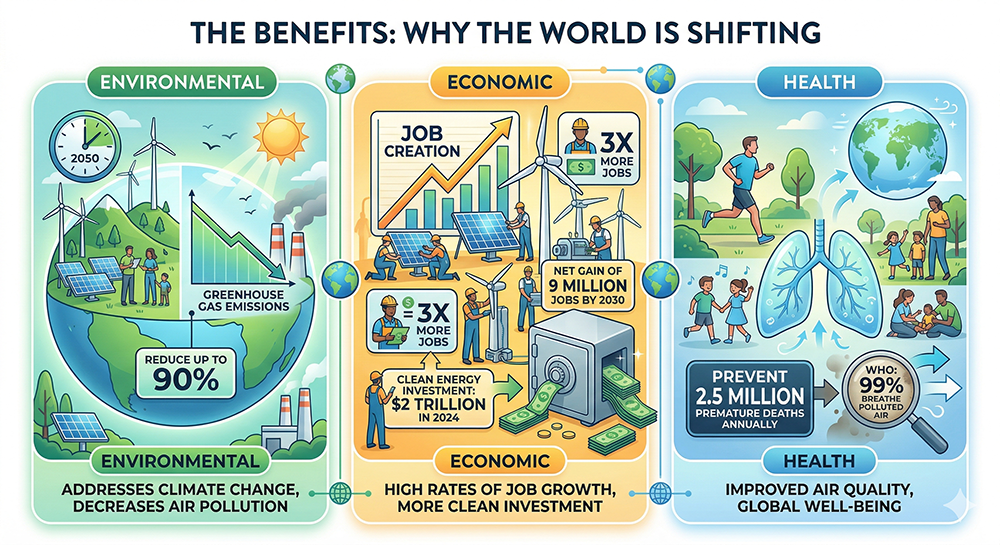
- Environmental: Renewable energy technologies could reduce global greenhouse gas emissions by up to 90 percent by 2050. This drastic reduction in emissions directly addresses climate change while also decreasing air pollution from fossil fuel combustion.
- Economic: The renewable energy sector creates jobs at a significantly higher rate than fossil fuels. Renewables generate three times more jobs per dollar invested than fossil fuels. The IEA projects that the transition to net zero could yield a net gain of 9 million jobs by 2030 (14 million created in clean energy offset by 5 million lost in fossil fuels). In 2024, global clean energy investment reached $2 trillion, $800 billion more than fossil fuels.
- Health: Improved air quality from reduced fossil fuel combustion could prevent 2.5 million premature deaths annually. The WHO reports that 99 percent of the world’s population breathes air exceeding quality limits, with pollutants mainly coming from fossil fuel burning. Transitioning to renewables therefore delivers tangible health benefits across the globe.
Challenges and Limitations
Despite their promise, renewable energy technologies face several significant hurdles that must be addressed for large‑scale deployment:
- Intermittency: Solar and wind generation depend on weather and time of day, creating variability that complicates grid management. The International Energy Agency estimates that digitally enabled demand response could reduce curtailment of variable renewable energy systems by more than 25 percent by 2030, but the underlying variability remains a fundamental challenge.
- Storage: Advanced battery technology is critical for storing excess energy when generation exceeds demand for use during periods of low output. Researchers are developing various grid‑scale battery energy‑storage technologies, including redox flow batteries and lithium‑ion systems, but each faces trade‑offs between safety, cost, lifetime and recyclability. Long‑duration energy storage capable of storing power for hundreds of hours remains an active area of research.
- Initial Costs: While operational costs for renewables are low, the upfront capital investment for infrastructure—including turbines, panels, geothermal wells and grid connections—remains high compared to traditional fossil fuel plants. At least 3,000 GW of renewable power projects are currently waiting in grid connection queues, indicating that grid infrastructure itself has become a bottleneck for the transition. Global electricity grids will require $25 trillion in investment by 2050 to achieve net‑zero emissions.
The Future of Renewable Energy
The future of renewable energy is intrinsically linked to the development of smart grids—electricity networks enhanced with digital technologies, sensors, and two‑way communication systems. Smart grids enable real‑time monitoring and adaptive control, allowing system operators to balance variable renewable generation with fluctuating demand more effectively. Digital technologies could save $1.8 trillion of grid investment globally through 2050 by extending the lifetime of existing grids and helping to integrate renewables. The falling costs of renewable technologies have already made them the cheapest option for new power plants in almost all countries. International climate goals, particularly the Paris Agreement target of tripling global renewable energy capacity by 2030, provide a policy framework driving continued expansion. With renewable capacity already doubling between 2015 and 2024, the trajectory toward a 100 percent renewable energy future appears increasingly inevitable.
Conclusion
Renewable energy represents a vital tool for addressing climate change, improving public health and creating sustainable economic growth. The transition from finite fossil fuels to perpetually replenished natural sources is not merely an environmental imperative but also an economic and social opportunity. Each individual can contribute to this shift by becoming more aware of their personal energy footprint, supporting policies that accelerate renewable adoption, and making informed choices about energy consumption in daily life.