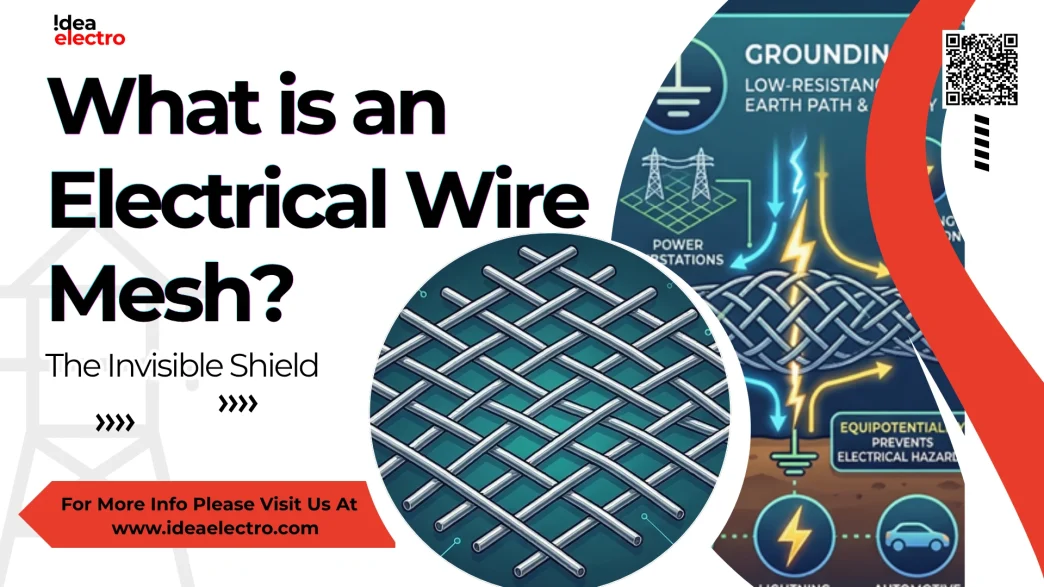
In the complex world of electronics and electrical systems, engineers devote considerable attention to individual wires, circuit boards, and components. Yet, there exists an often-overlooked element that serves as the silent guardian of these systems: the electrical wire mesh. This metallic lattice, typically composed of interwoven or welded conductive strands, functions as a critical infrastructure component for conductivity, protection, and electromagnetic shielding. From the server rooms that power the internet to the medical imaging devices that save lives, electrical wire mesh provides the invisible shield that ensures sensitive equipment operates safely and reliably in an increasingly electromagnetically congested world.
Defining Electrical Wire Mesh
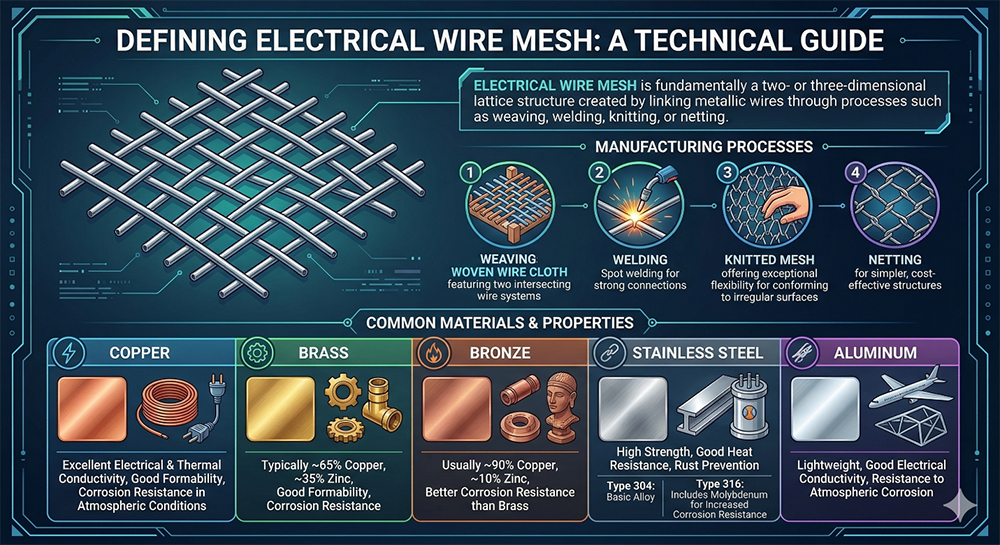
Electrical wire mesh is fundamentally a two- or three-dimensional lattice structure created by linking metallic wires through processes such as weaving, welding, knitting, or netting. The physical construction varies by application, with woven wire cloth featuring two intersecting wire systems and knitted mesh offering exceptional flexibility for conforming to irregular surfaces. The choice of material and weave pattern determines the mesh’s electrical and mechanical properties.
Common Materials:
- Copper– Offers excellent electrical and thermal conductivity with good formability and corrosion resistance in atmospheric conditions
- Brass– Typically composed of 65% copper and 35% zinc, providing good formability and corrosion resistance
- Bronze– Usually 90% copper with 10% zinc, offering better corrosion resistance than brass
- Stainless Steel– Provides high strength, good heat resistance, and rust prevention; Type 304 is the basic alloy, while Type 316 includes molybdenum for increased corrosion resistance
- Aluminum– Lightweight with good electrical conductivity and resistance to atmospheric corrosion
Key Characteristics:
- Wire diameter– Affects both mechanical strength and electrical conductivity
- Mesh count– Measured as openings per linear inch, determining shielding effectiveness and airflow
- Weave type– Plain weave (alternating over-under pattern), twill weave (wires pass over two and under two), or Dutch weave (dense structure with fine filtration capabilities)
Primary Functions: Why Do We Need It?
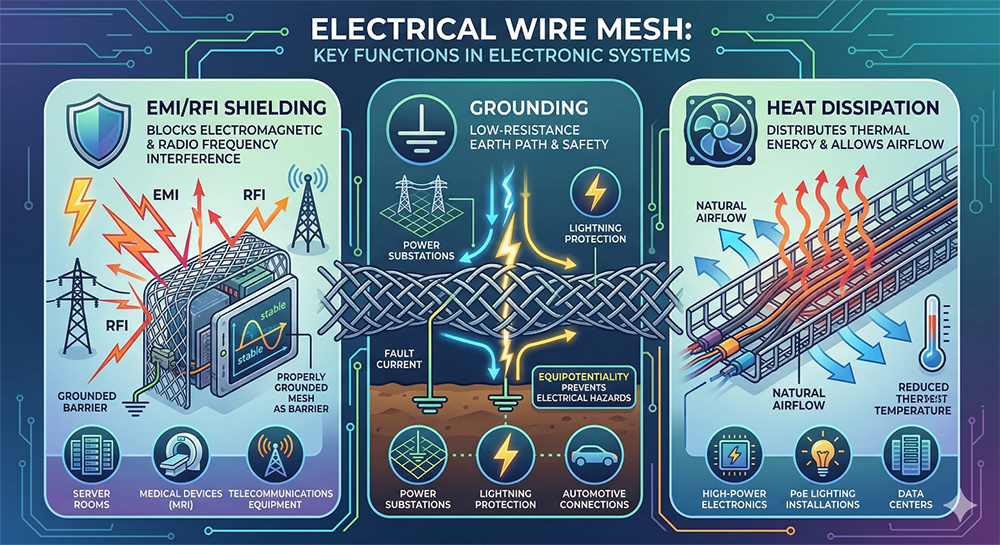
Electrical wire mesh serves multiple critical functions in modern electronic systems, with electromagnetic interference (EMI) and radio frequency interference (RFI) shielding representing perhaps its most vital role. EMI refers to electromagnetic energy that disrupts the normal functioning of electronic devices, originating from sources such as power lines, radio transmitters, and even natural occurrences like lightning strikes. RFI, a subset of EMI, specifically involves interference from radio frequency signals that can impair telecommunications systems, medical equipment, and sensitive electronics. When properly grounded, wire mesh acts as a barrier that blocks external electromagnetic signals from interfering with device operation while containing internal emissions.
| Function | Description | Primary Use Case |
| EMI/RFI Shielding | Blocks electromagnetic and radio frequency interference through conductive barrier action | Server rooms, medical devices (MRI), telecommunications equipment |
| Grounding | Provides a low-resistance path to earth for fault currents, ensuring equipotentiality and preventing electrical hazards | Power substations, lightning protection, automotive engine-to-chassis connections |
| Heat Dissipation | Distributes thermal energy across a larger surface area through the open-grid structure | High-power electronics, PoE lighting installations, data centers |
The grounding function is equally essential for safety. Grounding mesh establishes a low-resistance connection between metal structures, racks, electrical cabinets, and machines, maintaining equipotentiality within installations and preventing dangerous voltage differentials. In substation applications, engineers use mesh overlays to create a stiff ground grid that provides a reliable equipotential surface across the entire facility. Additionally, the open structure of wire mesh cable trays promotes natural heat dissipation by allowing airflow around cables, a critical feature in high-density installations where thermal buildup can compromise performance and longevity.
Common Applications Across Industries
Telecommunications
In telecommunications infrastructure, wire mesh protects sensitive data transmission from electrical “noise” that could corrupt signals or reduce bandwidth. The shielding effectiveness is particularly critical as data rates increase and systems become more susceptible to interference. Zippered mesh sleeving solutions allow for tool-free installation around cable bundles while maintaining 360-degree EMI protection.
Aerospace and Defense
Aerospace applications demand lightweight, flexible shielding solutions that can withstand harsh environments. Hardened shelters housing strategic command centers rely on Faraday cage integration to protect against high-altitude electromagnetic pulses (EMP), eavesdropping, and intrusion attempts. The French Ministry of Defense, for example, employs massive Faraday cages measuring up to 30 meters in length to ensure communication systems remain operational under extreme conditions.
Medical Technology
Medical environments present unique challenges where equipment sensitivity meets life-critical reliability. MRI machines, which detect minute magnetic resonance signals, require exceptional shielding from outside radio signals that could otherwise compromise image quality or patient safety. Wire mesh gaskets and shielding materials provide the necessary barrier while maintaining the flexibility required for equipment access and maintenance.
Architecture and Secure Facilities
Faraday cages integrated into building walls create secure environments where electronic eavesdropping is physically impossible. These installations, which may involve thousands of square feet of conductive mesh, are essential for government facilities, corporate data centers, and any location where sensitive information is discussed or processed. The mesh must be continuously bonded to maintain shielding effectiveness, as any gap can create a “leak” that compromises the entire installation.
Technical Selection: Choosing the Right Mesh
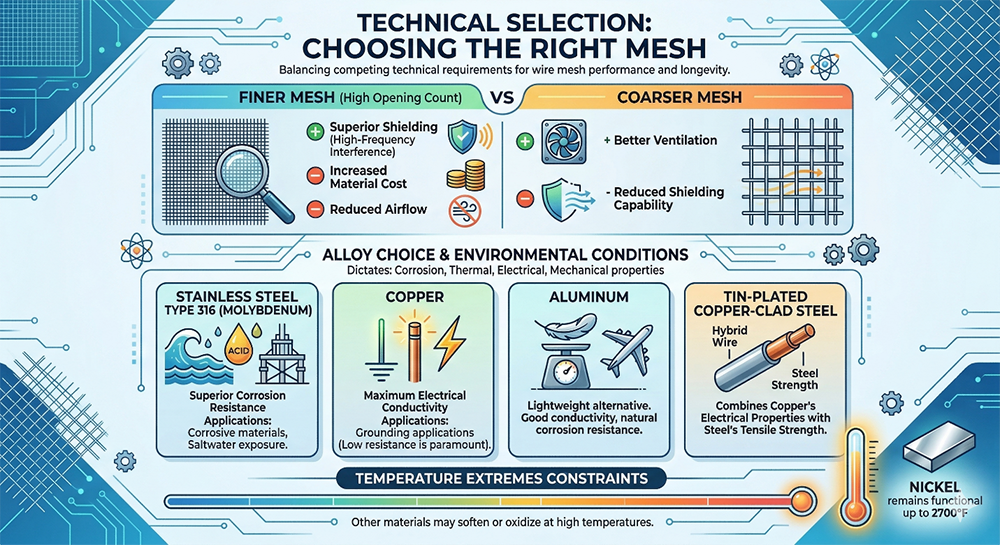
Selecting the appropriate wire mesh requires balancing competing technical requirements. The alloy choice dictates corrosion resistance, thermal characteristics, electrical conductivity, and mechanical strength—all critical factors in mesh performance and longevity. Finer mesh with higher opening counts generally offers superior shielding effectiveness against higher-frequency interference but comes with increased material cost and reduced airflow. Coarser mesh provides better ventilation at the expense of some shielding capability.
Environmental conditions heavily influence material selection. For applications involving corrosive materials or saltwater exposure, stainless steel Type 316 with its molybdenum content provides superior corrosion resistance. Copper offers maximum electrical conductivity—essential for grounding applications where low resistance is paramount—while aluminum provides a lightweight alternative with good conductivity and natural corrosion resistance. When both conductivity and mechanical strength are required, tin-plated copper-clad steel wire combines the electrical properties of copper with the tensile strength of steel. Temperature extremes further constrain selection, as different alloys maintain their properties across varying thermal ranges, with nickel remaining functional up to 2700°F while other materials may soften or oxidize.
 Installation and Maintenance Essentials
Proper installation is critical because even the highest-quality wire mesh will fail to perform if not correctly bonded and grounded. The mesh must maintain continuous electrical connectivity across all sections, with bonding at splice points to eliminate gaps in conductivity. For wire mesh cable trays, installers must verify electrical continuity throughout the entire system and ensure secure connection to the building grounding electrode system. Physical damage, oxidation at connection points, and gaps between mesh sections can all create “leaks” that compromise shielding effectiveness. In powder-coated trays, installers must scrape away coating at bonding points to ensure metal-to-metal contact. Regular inspection of ground connections and mesh integrity helps maintain long-term performance and safety compliance.
Conclusion: The Future of Conductive Mesh
As electronic devices become more numerous, more powerful, and more interconnected, the importance of effective EMI shielding and reliable grounding only increases. Electrical wire mesh, once a simple protective element, has evolved into an engineered solution critical for system performance and safety. Looking forward, “smart meshes” incorporating nanomaterials promise even greater shielding effectiveness with reduced weight and bulk, while advanced manufacturing techniques enable increasingly customized solutions for specialized applications. In a world where electromagnetic compatibility is no longer optional, the humble wire mesh stands as an indispensable guardian of modern electronics.