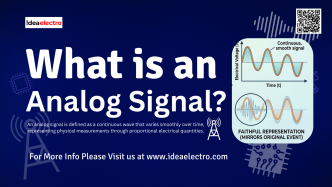
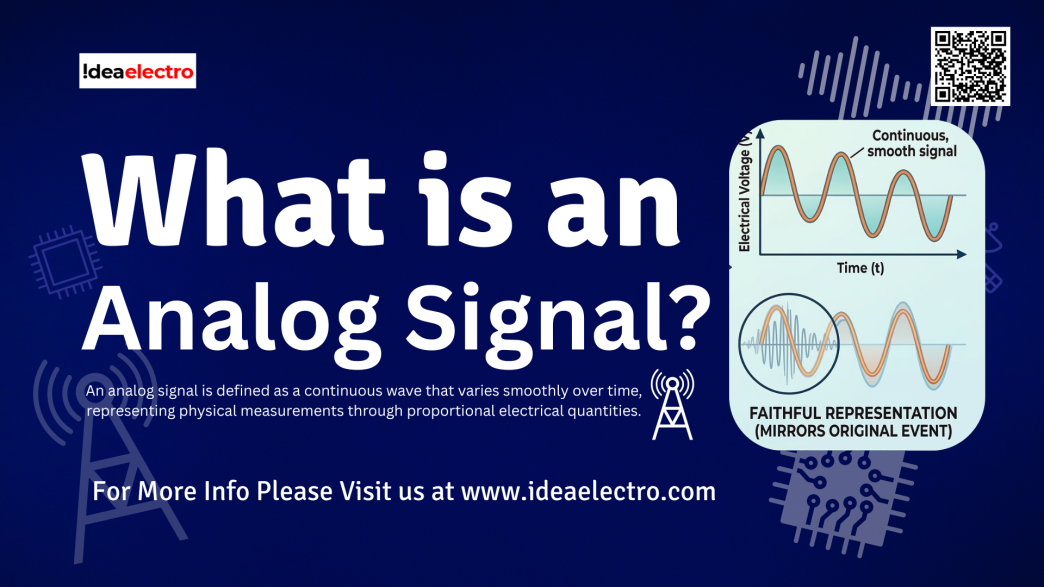
In the vast landscape of electrical engineering, the concept of a signal serves as the fundamental pulse of the physical world. An analog signal is defined as a continuous wave that varies smoothly over time, representing physical measurements through proportional electrical quantities. Unlike digital signals, which operate on a binary “on/off” or “high/low” logic, analog signals are capable of representing an infinite range of values within a given spectrum. A helpful analogy is the comparison between a traditional light switch and a dimmer switch. While a standard switch is strictly discrete (on or off), a dimmer switch allows for a continuous range of brightness, mirroring how analog signals capture the nuances of reality. According to the National Institute of Standards and Technology (NIST), these signals are crucial for interfacing with the physical environment.
The Anatomy of an Analog Wave
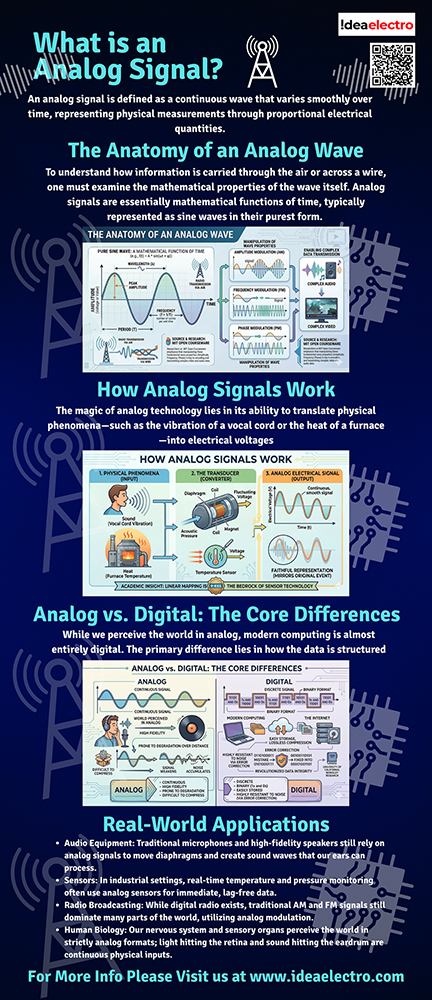
To understand how information is carried through the air or across a wire, one must examine the mathematical properties of the wave itself. Analog signals are essentially mathematical functions of time, typically represented as sine waves in their purest form. These waves possess specific characteristics that define the quality and nature of the data being transmitted. For instance, researchers at MIT’s Open Courseware highlight that the manipulation of these properties is what allows for the transmission of complex audio and video data.
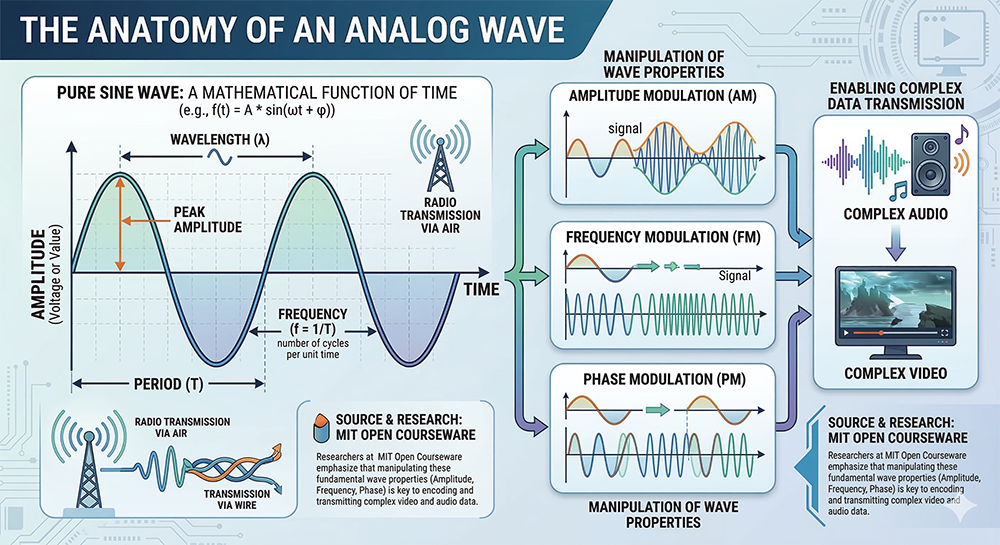
- Amplitude: This represents the “height” or maximum displacement of the wave from its central equilibrium. In practical terms, amplitude correlates to the intensity of the signal, such as the volume of a sound or the brightness of a light source.
- Frequency: Measured in Hertz (Hz), frequency denotes how often the wave repeats its cycle per second. In the realm of acoustics, a higher frequency translates to a higher pitch, whereas in radio, it determines the specific “channel” or band.
- Phase: This refers to the specific starting point of the wave relative to a time origin. Phase is critical in synchronization and complex modulation schemes used in modern telecommunications.
How Analog Signals Work
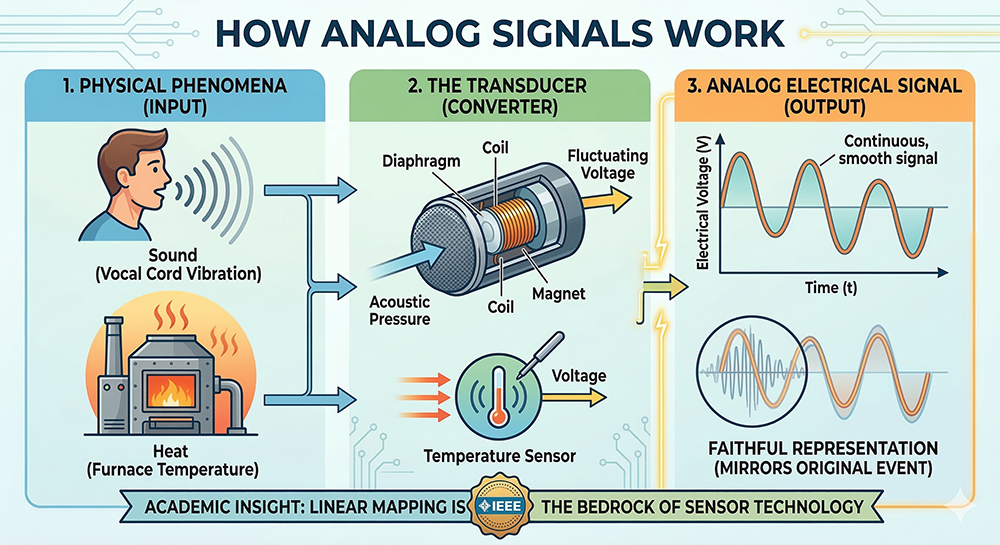
The magic of analog technology lies in its ability to translate physical phenomena—such as the vibration of a vocal cord or the heat of a furnace—into electrical voltages. This process is facilitated by transducers, which are devices that convert one form of energy into another. For example, a microphone uses a diaphragm to capture sound waves and convert them into a fluctuating voltage that mirrors the original acoustic pressure. This continuous relationship ensures that the electrical “copy” remains a faithful representation of the physical event. Academic resources from the Institute of Electrical and Electronics Engineers (IEEE) emphasize that this linear mapping is the bedrock of sensor technology.
| Physical Input | Analog Representation |
| Human Voice | Fluctuating Voltage via Microphone |
| Temperature | Varying Resistance in a Thermistor |
| Brightness | Changing Current in a Photoresistor |
Characteristics and Behavior
One of the most defining traits of an analog signal is its continuity. There are no breaks, “steps,” or “gaps” in the data stream; the signal flows as a steady, uninterrupted stream of information. This leads to the concept of infinite resolution. In theory, because the signal is continuous, it can represent an infinite number of values between any two points. However, this high level of detail comes with a significant drawback: susceptibility to noise. Because every small fluctuation in voltage is treated as part of the signal, external Electromagnetic Interference (EMI) or heat can easily distort the original wave. Unlike digital systems that can “ignore” small errors, analog systems incorporate the noise directly into the output.
Analog vs. Digital: The Core Differences
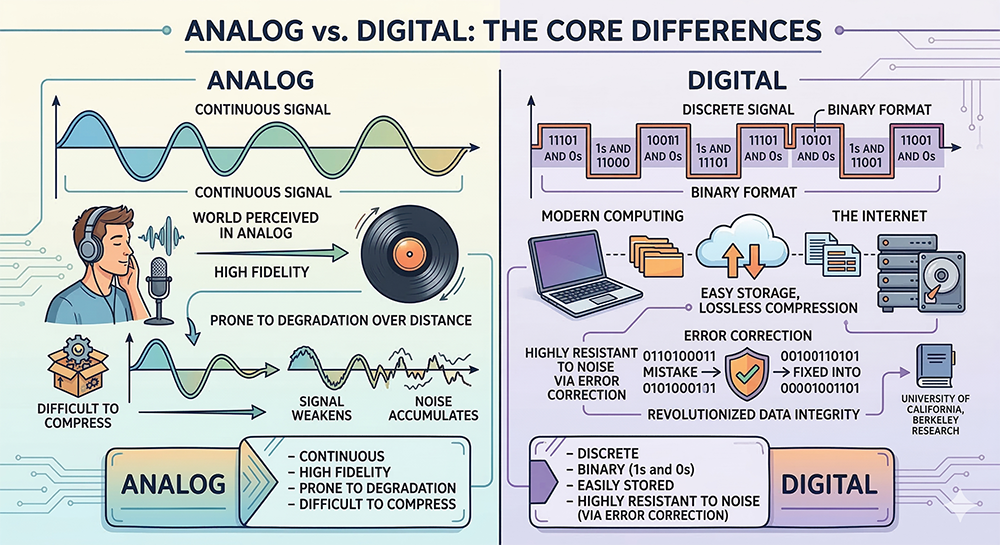
While we perceive the world in analog, modern computing is almost entirely digital. The primary difference lies in how the data is structured. Analog signals are continuous and offer high fidelity, making them ideal for high-end audio recording where every nuance matters. However, they are prone to degradation over long distances, as the signal weakens and noise accumulates. Digital signals, conversely, are discrete and binary, consisting of 1s and 0s. This format allows for easy storage, lossless compression, and error correction, which is why the internet and modern computers rely on them. Research published by the University of California, Berkeley, details how the transition from analog to digital revolutionized data integrity.
- Analog: Continuous, high fidelity, prone to degradation, difficult to compress.
- Digital: Discrete, binary, easily stored, highly resistant to noise via error correction.
Real-World Applications
Despite the digital revolution, analog signals remain indispensable in our daily lives. They serve as the bridge between the digital brain of our devices and the analog reality of our senses.
- Audio Equipment: Traditional microphones and high-fidelity speakers still rely on analog signals to move diaphragms and create sound waves that our ears can process.
- Sensors: In industrial settings, real-time temperature and pressure monitoring often use analog sensors for immediate, lag-free data.
- Radio Broadcasting: While digital radio exists, traditional AM and FM signals still dominate many parts of the world, utilizing analog modulation.
- Human Biology: Our nervous system and sensory organs perceive the world in strictly analog formats; light hitting the retina and sound hitting the eardrum are continuous physical inputs.
Conclusion: The Enduring Legacy of Analog
We live in an era defined by bits and bytes, yet the “interface” between technology and the real world will always remain fundamentally analog. From the moment a sensor detects a heartbeat to the second a speaker vibrates to play music, we are relying on the continuous, flowing nature of analog waves. While digital technology excels at processing and storage, analog remains the language of the physical universe, ensuring its place as a cornerstone of electrical engineering for generations to come.