Electric power manifests in different forms, but the most prevalent in our daily lives is alternating current, commonly abbreviated as AC. In fundamental terms, alternating current is defined as the flow of electric charge that periodically reverses its direction of movement Unlike a steady stream of water flowing in one direction through a pipe, the electrons in an AC circuit continuously oscillate back and forth. This dynamic shifting means that the voltage level also reverses along with the current, creating a versatile form of energy distribution.
The widespread adoption of this specific electrical format dates back to the late 19th century during a period often referred to as the War of the Currents. This historical technological rivalry pitted Thomas Edison, a proponent of direct current, against George Westinghouse and Nikola Tesla, who championed alternating current. Ultimately, Tesla’s alternating current triumphed due to its superior efficiency over long distances. Consequently, it was established as the global standard, and it remains the primary type of electricity supplied to homes, commercial buildings, and industrial facilities today.
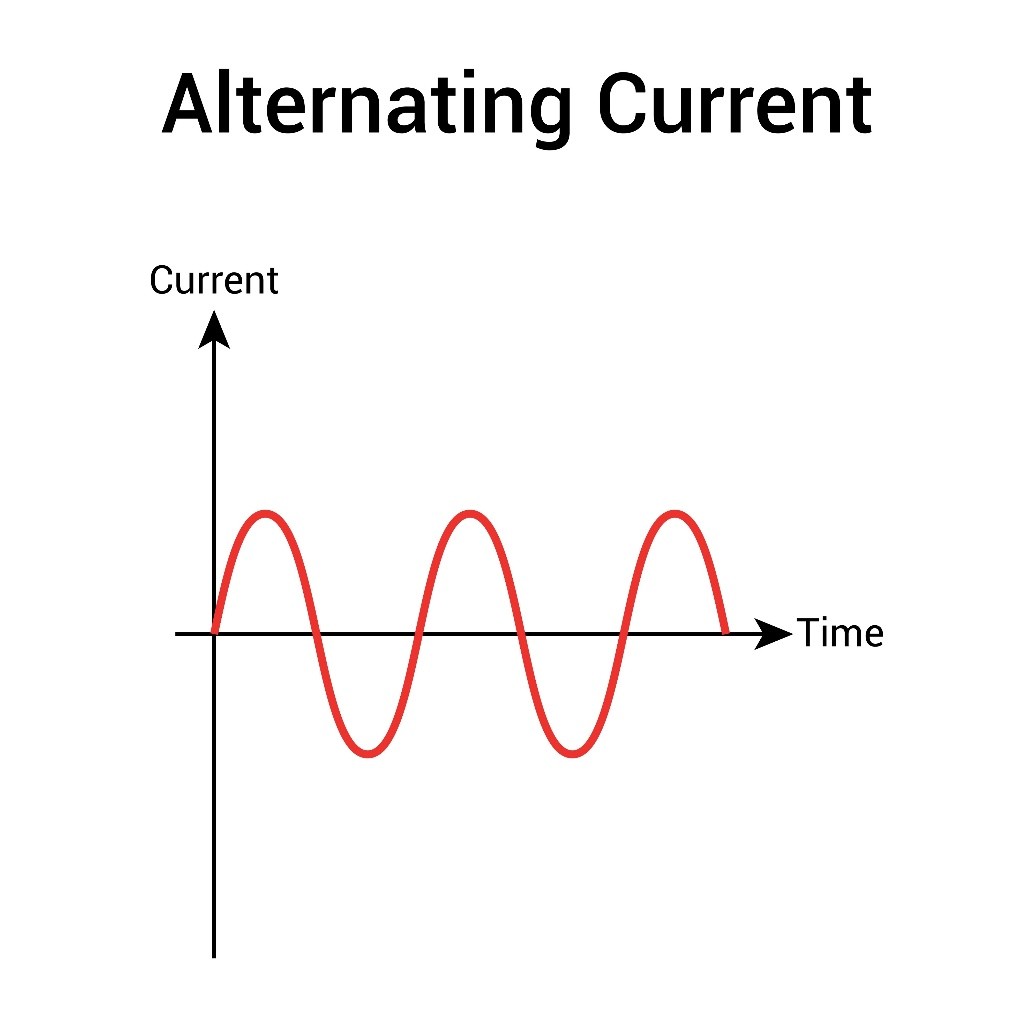
The generation of this fluctuating electrical flow relies heavily on the principles of electromagnetic induction, a physical phenomenon discovered by Michael Faraday. When a conductive material moves through a magnetic field, or when a magnetic field changes around a stationary conductor, an electromotive force or voltage is induced within that conductor, In the context of producing AC power, mechanical energy—often sourced from turbines driven by wind, water, or steam—is converted into electrical energy using a device known as an alternator or AC generator.
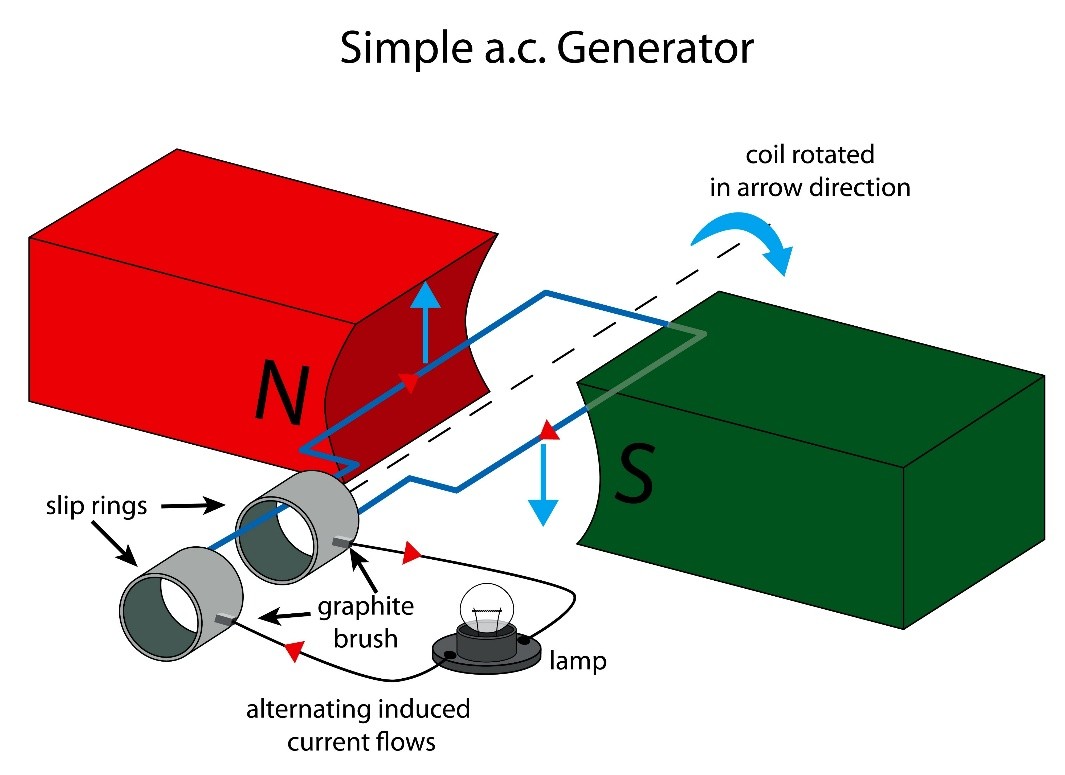
The operation of a basic alternator follows a specific, sequential process to produce this oscillating current:
- A central rotor, typically consisting of a wire coil, is mechanically forced to spin continuously within a stationary, powerful magnetic field.
- As the coil rotates through the first half of its circular path, it cuts through the magnetic lines of force in one specific orientation, inducing a current that flows in a forward direction.
- When the coil flips and enters the second half of its rotation, its orientation relative to the magnetic poles reverses, causing the induced polarity to flip and the electrons to be pushed in the opposite direction.
- This constant mechanical spinning results in a continuous push and pull of electrons, smoothly generating the alternating current that eventually travels into the power grid.
To accurately analyze and measure alternating current, engineers and scientists utilize visual representations known as waveforms. The most common and ideal shape for AC power is the sine wave, a smooth, repetitive curve that perfectly illustrates how the voltage and current gradually rise to a peak, fall to zero, reverse direction, and rise to a negative peak before repeating the process. Understanding this fluid motion requires familiarity with several foundational electrical metrics required to calculate and manage power distribution safely.
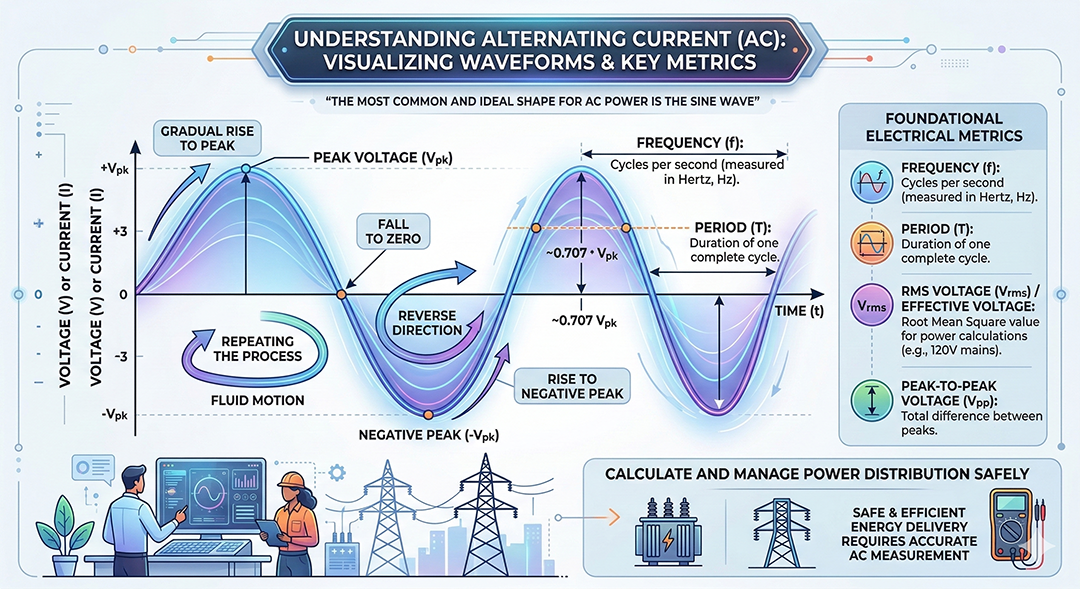
- Amplitude (Peak Voltage): This measurement refers to the maximum absolute value or highest point of voltage reached during a single wave, indicating the sheer strength of the electrical push before it begins to decline.
- Cycle: A cycle is defined as one complete sequence of the sine wave, encompassing the full positive progression and the full negative progression before returning to the starting position.
- Frequency (Hertz): This metric describes the speed of the oscillation, specifically counting the total number of complete cycles that occur within a single second. Depending on geographic location and historical infrastructure decisions, standard power grids operate at specific frequencies, most commonly 50Hz in regions like Europe and Asia, or 60Hz in North America.
- Period: Inversely related to frequency, the period is the exact amount of time, usually measured in fractions of a second, that it takes for the alternating current to complete one full cycle.
While alternating current dominates massive power generation and distribution networks, direct current (DC) plays an equally vital role in modern technology. Direct current is characterized by the unidirectional flow of electrical charge, meaning the electrons travel continuously in a single, unwavering forward direction. This stable, constant voltage is the type of power generated by solar panels and stored in standard batteries, making it the essential lifeblood for almost all portable electronic devices, from smartphones to electric vehicles.
| Feature | Alternating Current (AC) | Direct Current (DC) |
| Direction of Flow | Periodically reverses direction. | Flows constantly in one direction. |
| Source | Alternators and AC generators. | Batteries, fuel cells, and solar panels. |
| Voltage Control | Easily stepped up or down using transformers. | Difficult to change voltage efficiently without complex electronic circuitry. |
| Primary Applications | Household electrical outlets, heavy industrial motors, and long-distance power grids. | Portable electronics, electric vehicles, telecommunications, and computer internals. |
The ubiquitous nature of alternating current is not accidental; it is driven by several distinct advantages that make it highly suitable for large-scale energy networks.
- Power Transmission: The most significant benefit of AC is its compatibility with transformers, simple devices that can easily and efficiently alter voltage levels without moving parts. Power plants step up the AC voltage to extremely high levels to minimize energy loss over hundreds of miles of transmission lines, and then local substations step it down to safer levels before it enters residential neighborhoods.
- Home Appliances: The vast majority of heavy-duty household equipment, including refrigerators, washing machines, and HVAC (heating, ventilation, and air conditioning) systems, utilize AC motors. These motors are generally more robust, simpler to manufacture, and more reliable than their DC counterparts when operating directly from high-power grid electricity.
- Cost-Effectiveness: Building the infrastructure for alternating current, from the massive synchronous generators at hydroelectric dams to the expansive network of elevated transmission cables, is highly economical on a macro scale. The ability to use thinner wires for high-voltage, low-current transmission significantly reduces the raw material costs associated with copper and aluminum wiring across a vast geographic area.
In summary, alternating current is the dynamic, oscillating flow of electrical energy that powers the vast majority of our civilized world. Through the principles of electromagnetic induction, mechanical movement is efficiently translated into a versatile power source characterized by its distinct sine wave, frequency, and amplitude. While direct current is absolutely crucial for our digital electronics, battery-powered tools, and sustainable solar storage, alternating current remains the undeniable fundamental backbone of the modern global power grid due to its unparalleled efficiency in generation and its ability to transmit energy over vast distances with minimal loss.