

The modern world is filled with devices that communicate without wires, from smart light bulbs to sophisticated industrial sensors. At the heart of this wireless ecosystem lies a small but powerful component known as the Wi-Fi module. A Wi-Fi module is a self-contained integrated circuit that provides devices with the ability to connect to a wireless network and, by extension, the internet. These components are engineered to convert standard communication interfaces like serial ports into wireless links, effectively embedding internet connectivity into everyday objects. Initially, such technology was expensive and reserved for industrial equipment, but advancements in manufacturing and design have transformed Wi-Fi modules into affordable, ubiquitous components found in millions of household items, forming the backbone of the Internet of Things (IoT).
The Anatomy of a Wi-Fi Module
Under the metallic shielding of a Wi-Fi module lies a sophisticated system-on-chip (SoC) design. The core components work together to manage data and radio communications:
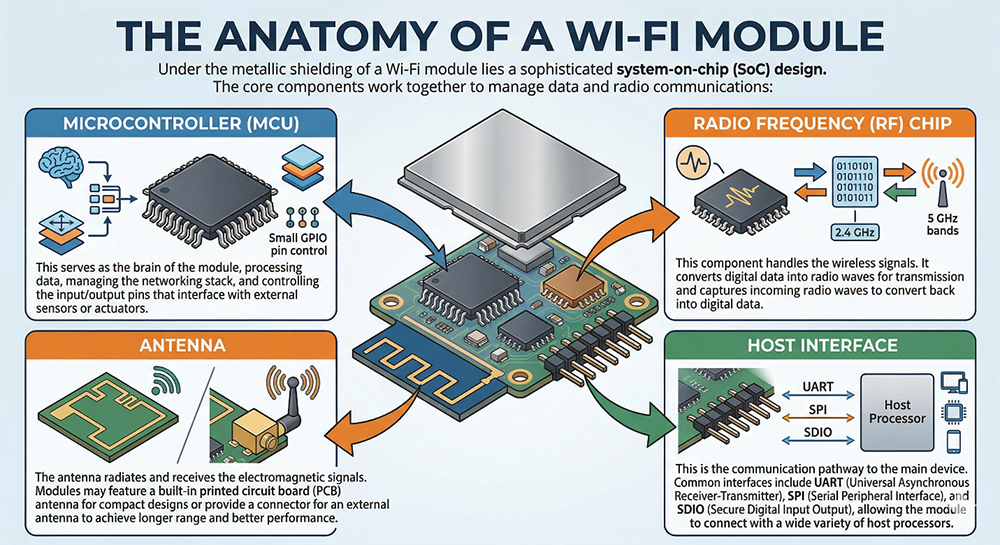
- Microcontroller (MCU):This serves as the brain of the module, processing data, managing the networking stack, and controlling the input/output pins that interface with external sensors or actuators.
- Radio Frequency (RF) Chip:This component handles the wireless signals. It converts digital data into radio waves for transmission and captures incoming radio waves to convert back into digital data.
- Antenna:The antenna radiates and receives the electromagnetic signals. Modules may feature a built-in printed circuit board (PCB) antenna for compact designs or provide a connector for an external antenna to achieve longer range and better performance.
- Host Interface:This is the communication pathway to the main device. Common interfaces include UART (Universal Asynchronous Receiver-Transmitter), SPI (Serial Peripheral Interface), and SDIO (Secure Digital Input Output), allowing the module to connect with a wide variety of host processors.
How Does a Wi-Fi Module Work?
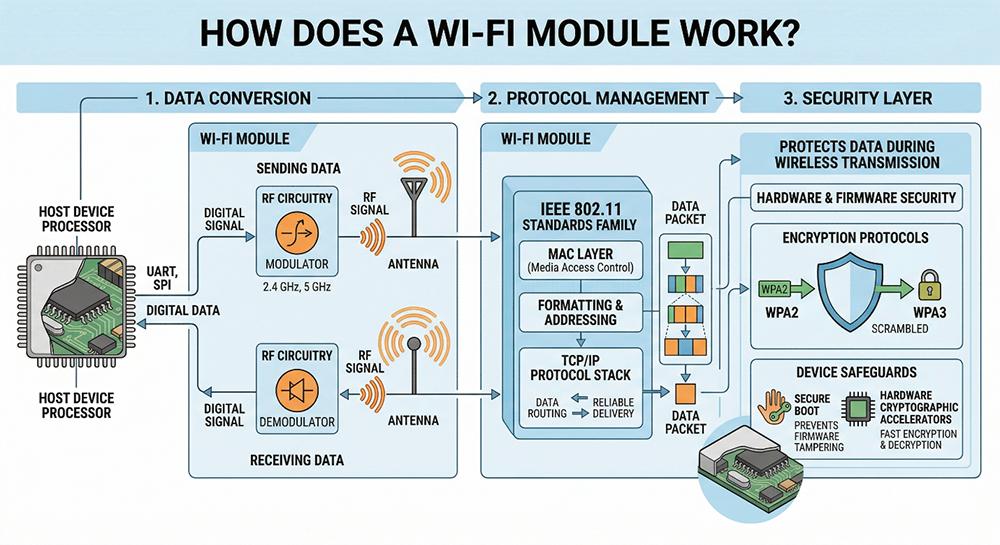
The functionality of a Wi-Fi module is a process of conversion and protocol management. The process can be broken down into three distinct stages:
- Data Conversion:The process begins when the device’s main processor sends data to the module via interfaces like UART or SPI. The module then converts this electrical data into radio waves. The RF circuitry modulates the digital signal onto a specific frequency channel, typically in the 2.4 GHz or 5 GHz bands, and transmits it through the antenna. Conversely, when receiving data, the module captures radio waves and demodulates them back into digital signals for the host device.
- Protocol Management:Wi-Fi modules are built around the IEEE 802.11 family of standards. They manage the complex protocols within this standard, handling media access control (MAC) and ensuring data packets are properly formatted and addressed. The module also contains a built-in TCP/IP protocol stack, which manages data routing and ensures reliable delivery across networks.
- Security Layer:To protect data during wireless transmission, the module implements hardware and firmware-level security. Modern modules support WPA2 and the newer WPA3 encryption protocols, which scramble the data to prevent eavesdropping. Many modules also incorporate secure boot and hardware cryptographic accelerators to safeguard the device from unauthorized access and firmware tampering.
 Key Types of Wi-Fi Modules
Choosing the right module requires understanding the trade-offs between power, performance, and application. The table below contrasts two common categories:
| Feature | Low-Power (IoT) | High-Performance |
| Typical Model | ESP8266 / ESP32 | Intel Dual Band / Wi-Fi 7 Chipsets |
| Best For | Smart bulbs, sensors, wearables | Laptops, routers, 4K video streaming |
| Power Use | Extremely Low (µA in sleep mode) | High (requires constant power supply) |
| Speed | Up to 150 Mbps (802.11n) | 1 Gbps+ (802.11ac/ax/be) |
The low-power category prioritizes energy efficiency, often featuring deep-sleep modes that consume microamps of current, making them ideal for battery-powered devices. High-performance modules focus on maximum throughput and low latency, supporting wider channels and advanced features like MU-MIMO to handle data-intensive tasks.
Popular Wi-Fi Modules in the Industry
Within the electronics community, two modules have achieved legendary status: the ESP8266 and its successor, the ESP32, both developed by Espressif Systems. The ESP8266, launched in 2014, revolutionized the industry by offering a fully functional Wi-Fi solution at an unprecedentedly low cost, enabling hobbyists and professionals to add wireless connectivity to projects for just a few dollars. Its successor, the ESP32, expanded upon this foundation by adding a dual-core processor, more memory, a wider array of GPIO pins, and integrated Bluetooth Classic and Low Energy (BLE). The massive open-source community support surrounding these modules has made them the gold standard for prototyping and commercial IoT products alike.
Common Applications: Where Do We Find Them?
Wi-Fi modules have become integral to numerous sectors due to their flexibility and ease of integration.
- Smart Home:This is the most visible application, found in smart thermostats, security cameras, voice assistants, and smart plugs that allow for remote monitoring and control via smartphones.
- Industrial IoT (IIoT):In factories and warehouses, Wi-Fi modules are used in machinery monitoring systems, environmental sensors, and automated guided vehicles (AGVs) to collect data and enable predictive maintenance.
- Healthcare:Medical devices such as wearable heart rate monitors, continuous glucose monitors, and portable patient tracking systems utilize Wi-Fi to transmit critical data to healthcare providers in real-time.
- Automotive:Modern electric vehicles (EVs) use Wi-Fi modules to perform over-the-air (OTA) software updates, ensuring that the vehicle’s infotainment and critical control systems stay current without requiring a trip to the dealership.
Choosing the Right Module: Factors to Consider
Selecting the appropriate Wi-Fi module for a project requires a careful evaluation of technical constraints and application requirements. Developers should consider the following:
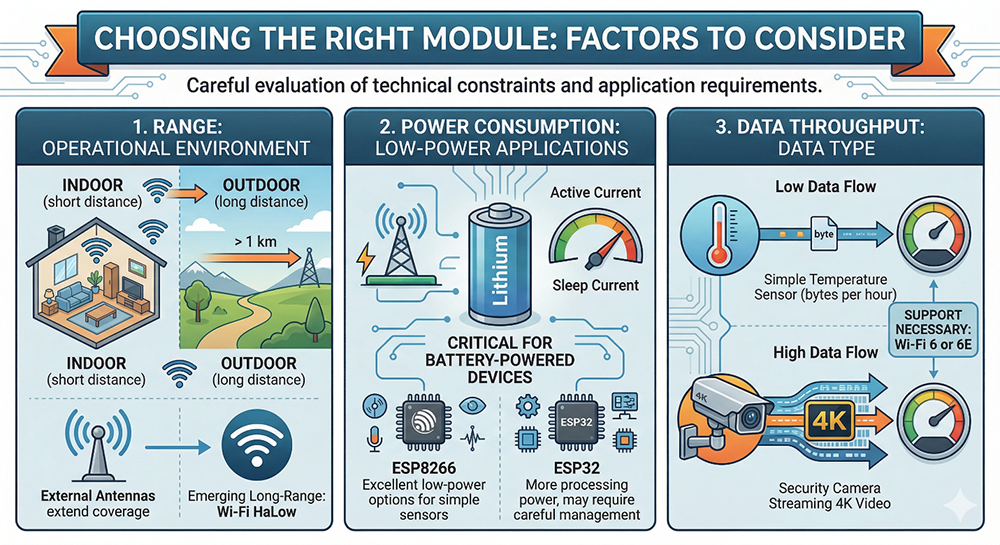
- Range:Determine whether the device will operate indoors or outdoors. For long-range applications requiring over a kilometer, specialized technologies like Wi-Fi HaLow are emerging, though standard modules with external antennas can also extend coverage.
- Power Consumption:This is critical for battery-powered devices. Evaluate the module’s sleep current versus active current. The ESP8266 offers excellent low-power options for simple sensors, while the ESP32 provides more processing power but may require careful power management.
- Data Throughput:Assess the type of data being transmitted. A simple temperature sensor sending a few bytes per hour requires far less bandwidth than a security camera streaming 4K video, which would necessitate a module supporting Wi-Fi 6 or 6E.
The Future of Connectivity
Wi-Fi modules continue to evolve beyond simple connectivity, becoming foundational elements in the expanding Internet of Things. The industry is currently shifting toward Wi-Fi 6 and Wi-Fi 7 technologies, which offer greater network efficiency, higher data rates, and improved power management for dense device environments. Innovations such as Wi-Fi Aware enable devices to discover and communicate directly with each other without a traditional access point, opening new possibilities for peer-to-peer applications. As these technologies mature, Wi-Fi modules will remain critical in bridging the gap between the physical and digital worlds, enabling smarter homes, more efficient industries, and a seamlessly connected future.