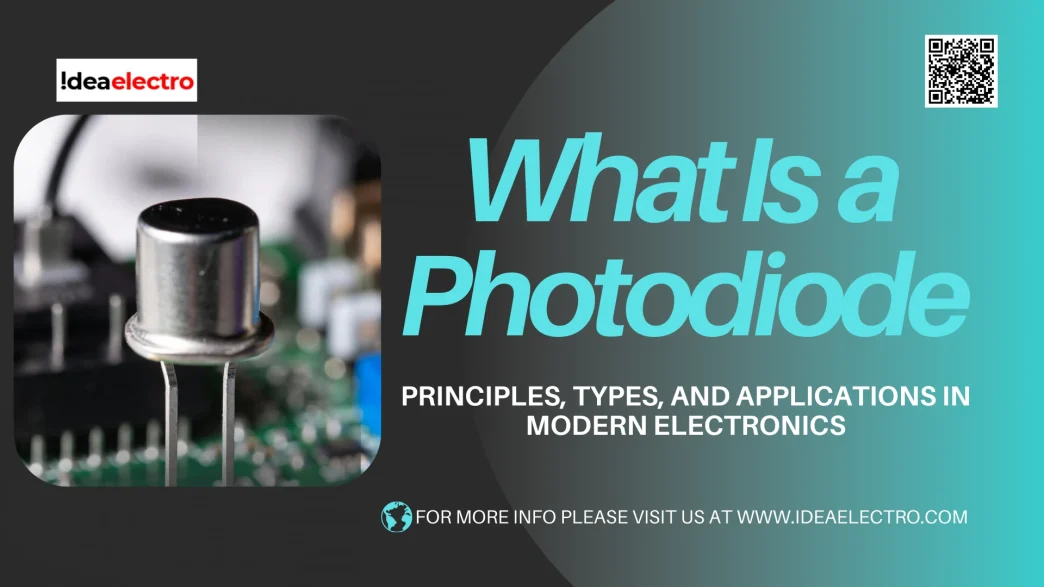
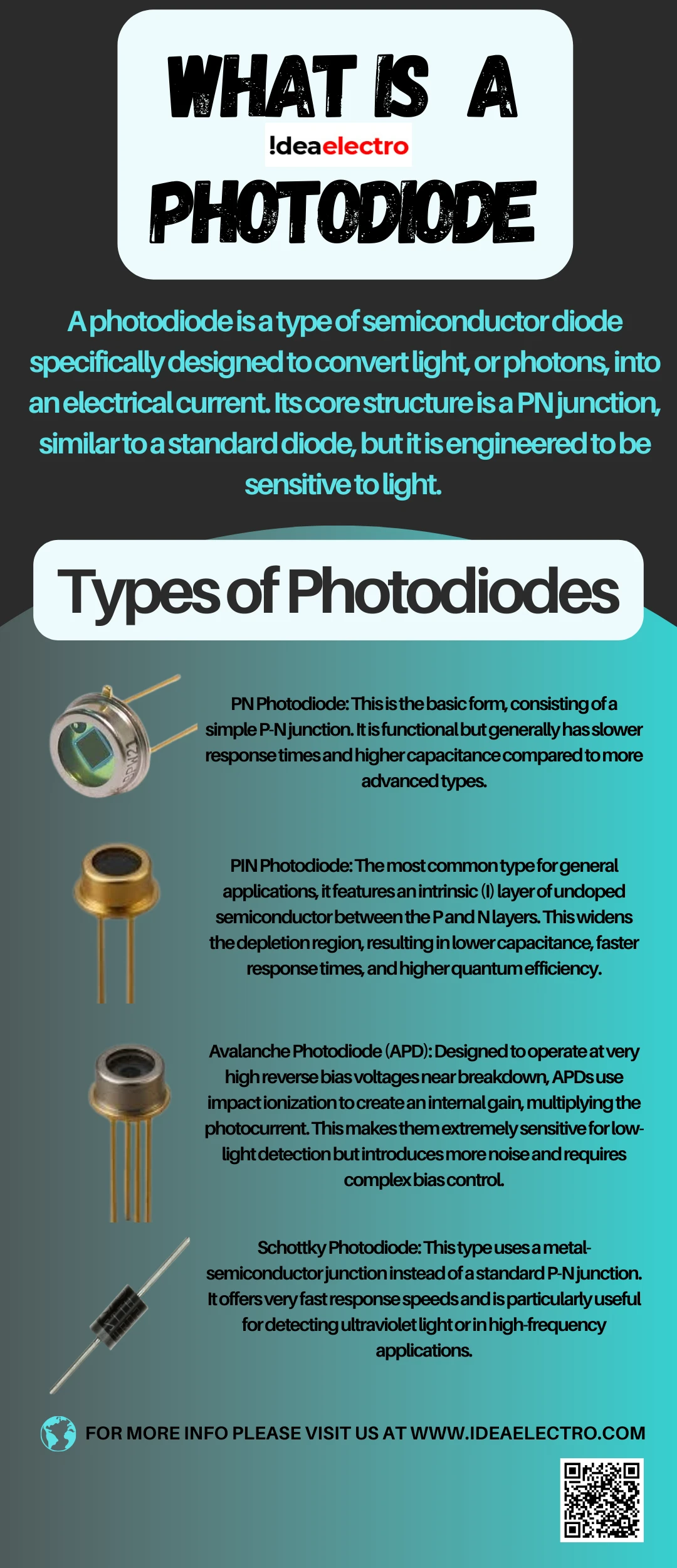
A photodiode is a type of semiconductor diode specifically designed to convert light, or photons, into an electrical current. Its core structure is a PN junction, similar to a standard diode, but it is engineered to be sensitive to light. When light energy strikes the active area of the photodiode, it causes the generation of electron-hole pairs within the semiconductor material. An internal electric field then sweeps these charge carriers apart, producing a measurable flow of electrical current. This photocurrent is directly proportional to the intensity of the incident light, making the photodiode an effective and reliable light sensor.
Principles, Types, and Applications in Modern Electronics
In the world of optoelectronics, few components are as fundamental as the photodiode. These semiconductor devices act as the electronic eyes for countless systems, translating light into electrical signals that machines and circuits can understand and act upon. From high-speed fiber-optic internet to the simple automatic light in a hallway, photodiodes enable modern technology to interact with its environment. This article provides a clear, research-based overview of what a photodiode is, how it functions, and where it is used.
Basic Working Principle of a Photodiode
The operation of a photodiode is rooted in the photoelectric effect. When photons with sufficient energy strike the semiconductor, they transfer their energy to electrons, freeing them from their atomic bonds and creating mobile electron-hole pairs. The efficiency of this process depends heavily on the device’s internal structure and how it is connected in a circuit.
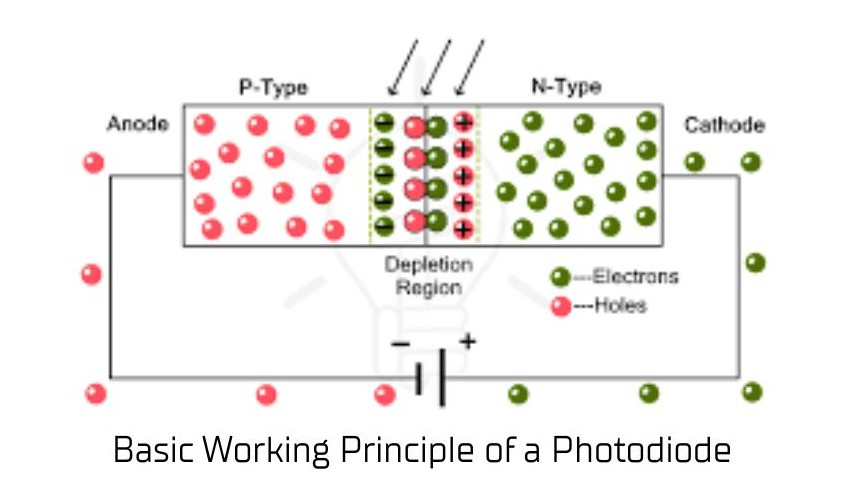
- Reverse Bias Operation: For optimal performance in most sensing applications, photodiodes are operated in reverse bias. This means a voltage is applied with the cathode positive relative to the anode. This external voltage widens the depletion region(an area devoid of free charge carriers), which is critical for efficient operation.
- Current Generation: When light strikes the photodiode, the electron-hole pairs generated within the depletion region are swiftly separated by the strong internal electric field. This movement of charge constitutes the photocurrent, which flows in the reverse direction through the circuit.
- Light Intensity Relationship: The magnitude of the generated photocurrent is linearly proportionalto the intensity of the incident light over a wide range. This linearity is a key advantage, allowing photodiodes to be used for precise light measurements.
Construction of a Photodiode
The internal construction of a photodiode is tailored to maximize its sensitivity to light. The primary functional unit is the PN junction, formed by joining P-type (positively charged hole carriers) and N-type (negatively charged electron carriers) semiconductor materials.
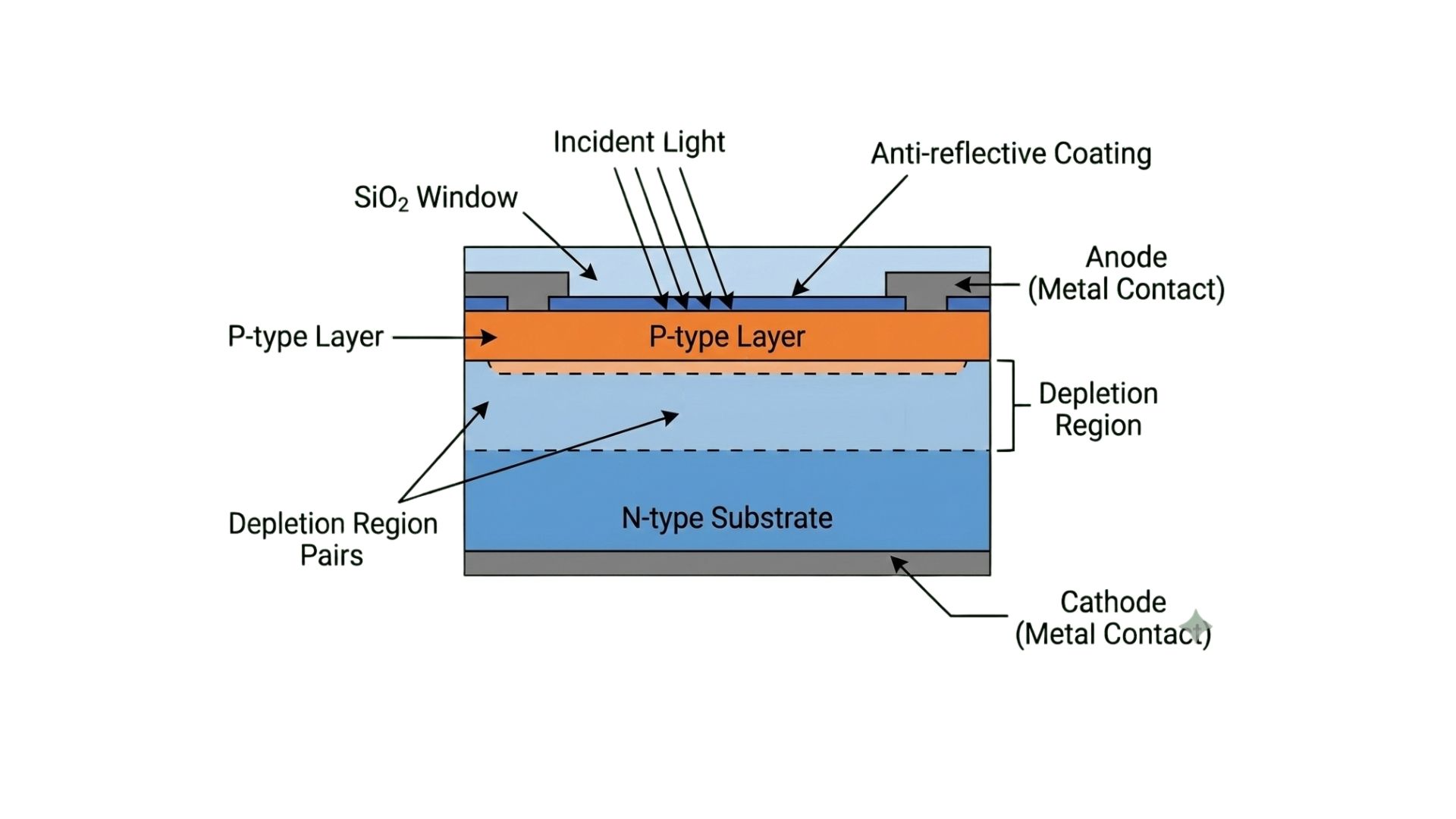
- Semiconductor Material: The choice of material—such as Silicon, Germanium, or Indium Gallium Arsenide—defines the range of light wavelengths (e.g., visible or infrared) the diode can detect. Silicon is common for visible light, while other materials are used for specialized infrared applications.
- Transparent Window or Lens: The diode is packaged with a transparent window, lens, or sometimes an optical fiber port. This allows light to reach the sensitive PN junction while protecting the semiconductor.
- Metal Contacts: Electrical connections are made via metal contacts to the P and N regions, forming the anodeand cathode These contacts are often designed to be small to leave a large active area for light detection.
Types of Photodiodes
Several specialized types of photodiodes have been developed to meet different performance requirements, such as speed, sensitivity, and wavelength range.
- PN Photodiode: This is the basic form, consisting of a simple P-N junction. It is functional but generally has slower response times and higher capacitance compared to more advanced types.
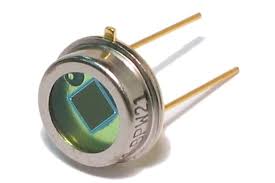
- PIN Photodiode: The most common type for general applications, it features an intrinsic (I) layerof undoped semiconductor between the P and N layers. This widens the depletion region, resulting in lower capacitance, faster response times, and higher quantum efficiency.

- Avalanche Photodiode (APD): Designed to operate at very high reverse bias voltages near breakdown, APDs use impact ionizationto create an internal gain, multiplying the photocurrent. This makes them extremely sensitive for low-light detection but introduces more noise and requires complex bias control.
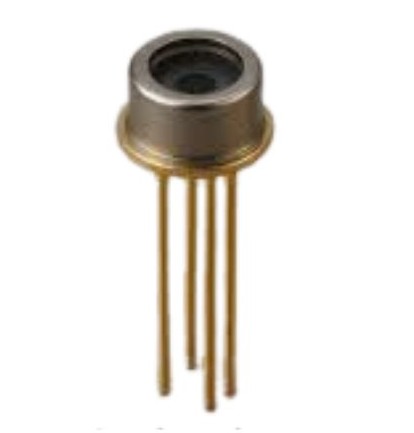
- Schottky Photodiode: This type uses a metal-semiconductor junction instead of a standard P-N junction. It offers very fast response speedsand is particularly useful for detecting ultraviolet light or in high-frequency applications.
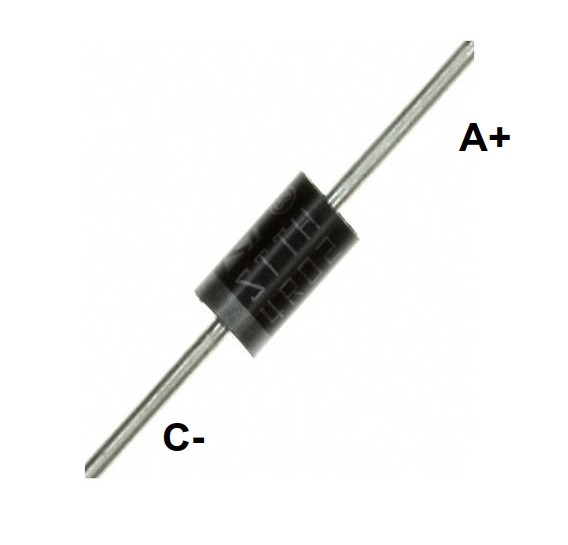
Photodiode Symbol and Circuit Diagram
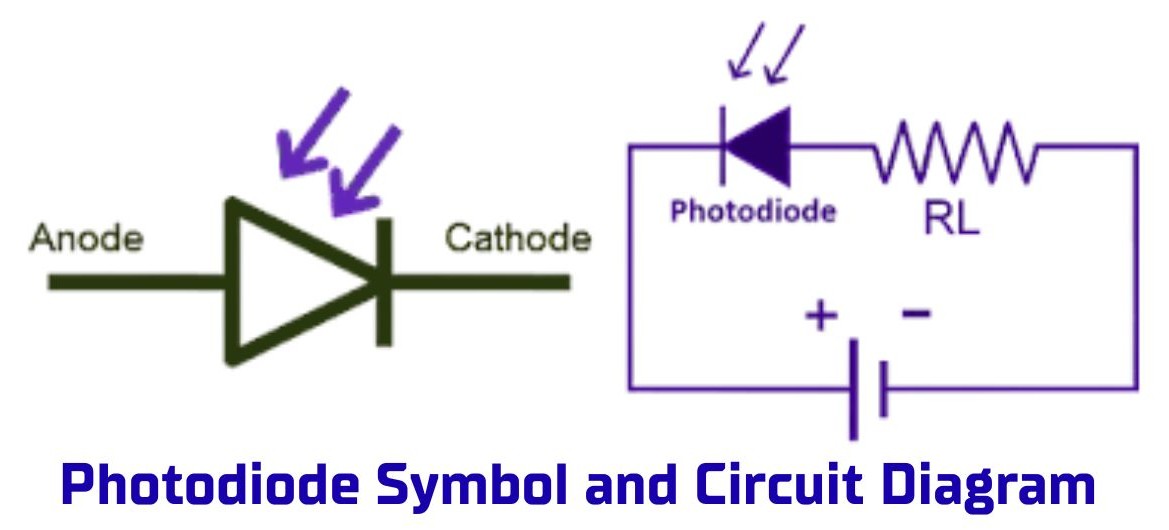
In circuit schematics, a photodiode is represented by a diode symbol with two arrows pointing inward toward the cathode, signifying the incoming light. This distinguishes it from an LED (Light Emitting Diode), whose arrows point outward. In a typical application circuit, the photodiode is placed in series with a power supply and a load resistor. It is almost always connected in reverse bias for sensing applications, with the cathode connected to the positive supply voltage and the anode connected through the load resistor to ground.
Modes of Operation of Photodiode
Photodiodes can function in two primary modes, each with distinct advantages suited for different applications.
Table: Comparison of Photodiode Operating Modes
| Feature | Photovoltaic Mode (Zero Bias) | Photoconductive Mode (Reverse Bias) |
| Bias Condition | No external voltage applied. | A reverse voltage is applied. |
| Speed | Slower response due to higher junction capacitance. | Faster response; bias widens depletion region, lowering capacitance. |
| Sensitivity & Noise | Very low dark current, minimizing noise. Ideal for precision low-light measurement. | Higher dark current, which increases noise, but offers greater sensitivity for modulated light. |
| Typical Use | Solar cells, low-frequency light meters. | Optical communications, high-speed switching, most sensor circuits. |
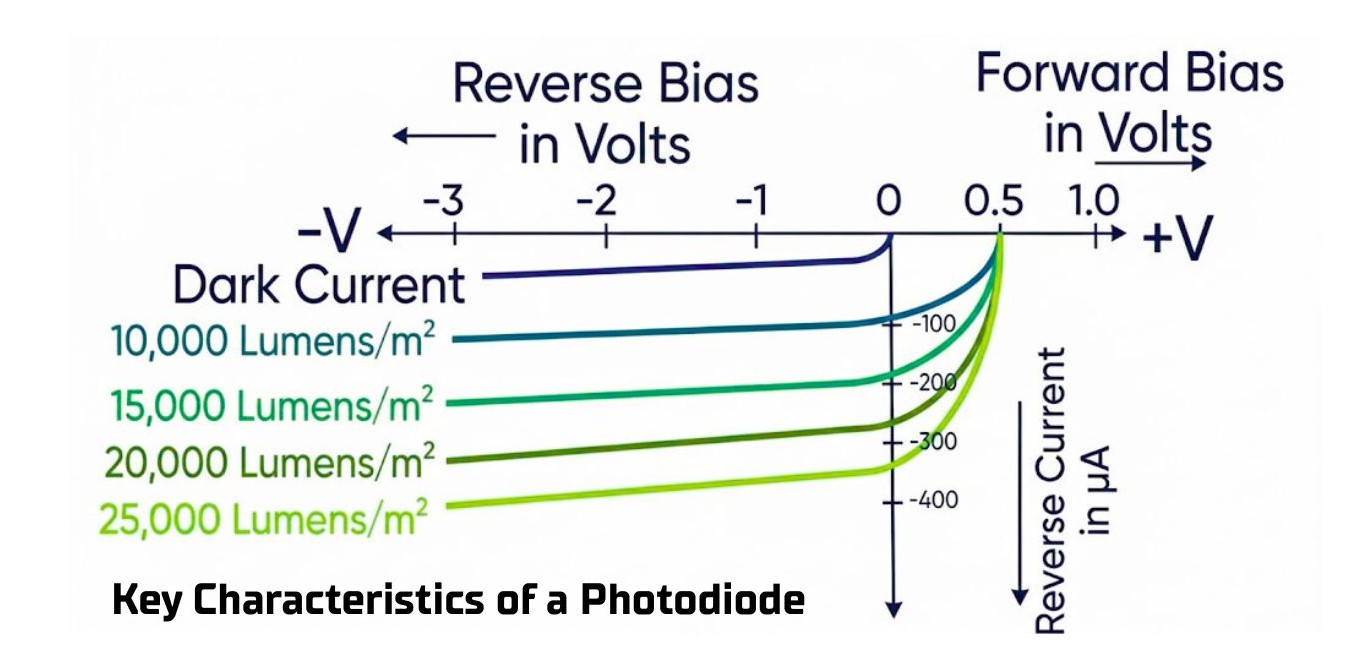
Key Characteristics of a Photodiode
When selecting a photodiode for a project, engineers evaluate several critical performance parameters:
- Responsivity: This measures how effectively the diode converts light into current, expressed in amperes per watt (A/W). It varies with the wavelength of the incident light.
- Dark Current: The small current that flows through the reverse-biased photodiode even in complete darkness. It is a primary source of noise and increases with temperature.
- Response Time: The time it takes for the diode to respond to a change in light intensity, determining its maximum operating speed or bandwidth.
- Spectral Sensitivity: The range of light wavelengths (e.g., infrared, visible, ultraviolet) to which the photodiode will respond, determined by its semiconductor material.
Applications of Photodiodes
The unique properties of photodiodes make them indispensable across a vast array of industries:
- Optical Communication Systems: PIN and avalanche photodiodes are the core receivers in fiber-optic networks, converting high-speed light pulses into electrical data signals.
- Light Meters and Environmental Sensors: Used in cameras, solar light meters, and UV index detectors for accurate light intensity measurement.
- Safety Systems: Form the sensing element in smoke detectorsby detecting light scattered by smoke particles.
- Medical Devices: Essential in pulse oximeters, where they measure light absorption through tissue to determine blood oxygen saturation.
- Consumer Electronics: Serve as receivers for infrared remote controlsand are embedded in various smart devices.
Advantages and Disadvantages of Photodiode
Like any component, photodiodes present a balance of strengths and limitations.
Advantages:
- Fast Response Time: Especially PIN and Schottky types, capable of nanosecond-level switching.
- Compact Size and High Reliability: Small, robust, solid-state devices with long operational lifespans.
- Linear Output and Low Noise: Provide a current directly proportional to light intensity, enabling precise measurement.
Disadvantages:
- Requires Amplification: The output photocurrent is very small (microamperes), often needing a subsequent amplifier circuit (like a transimpedance amplifier) for practical use.
- Temperature Sensitivity: Performance parameters, particularly dark current, are sensitive to temperature changes, which can affect accuracy in uncontrolled environments.
Photodiode vs Phototransistor
Photodiodes are often compared to phototransistors, another common light-sensing device. While both convert light to current, a phototransistor integrates a photodiode with a transistor to provide internal signal amplification.
Table: Photodiode vs. Phototransistor
| Criteria | Photodiode | Phototransistor |
| Sensitivity | Lower raw sensitivity; outputs a small current. | Higher sensitivity due to internal gain; outputs a larger, amplified current. |
| Speed | Very fast (nanoseconds to microseconds). Excellent for high-frequency light. | Slower (microseconds to milliseconds). Limited by transistor switching speed. |
| Output Linearity | Highly linear over a wide range. | Less linear; output can saturate more easily. |
| Typical Applications | High-speed data reception, precision light measurement. | Simple object detection, opto-isolators, slow-speed switching (e.g., automatic night lights). |
Conclusion
In summary, a photodiode is a specialized semiconductor device that serves as a critical interface between the optical and electronic worlds. By leveraging the photoelectric effect within a PN junction, it provides a reliable and linear means of detecting light intensity. From the fundamental PN type to the high-speed PIN and sensitive avalanche diodes, its various forms enable technologies as diverse as global internet infrastructure, medical diagnostics, and everyday consumer gadgets. As technology continues to evolve toward greater connectivity and sensing capability, the photodiode will undoubtedly remain a foundational component in the advancement of light-based technologies.