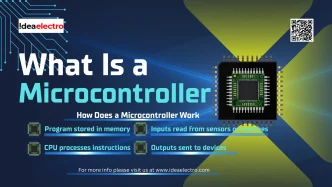
Technically, a microcontroller (often abbreviated as MCU) is a small computer on a single metal-oxide-semiconductor (MOS) integrated circuit chip. It essentially functions as a “single-chip computer” because it houses a processor, memory, and input/output peripherals all within one unit.
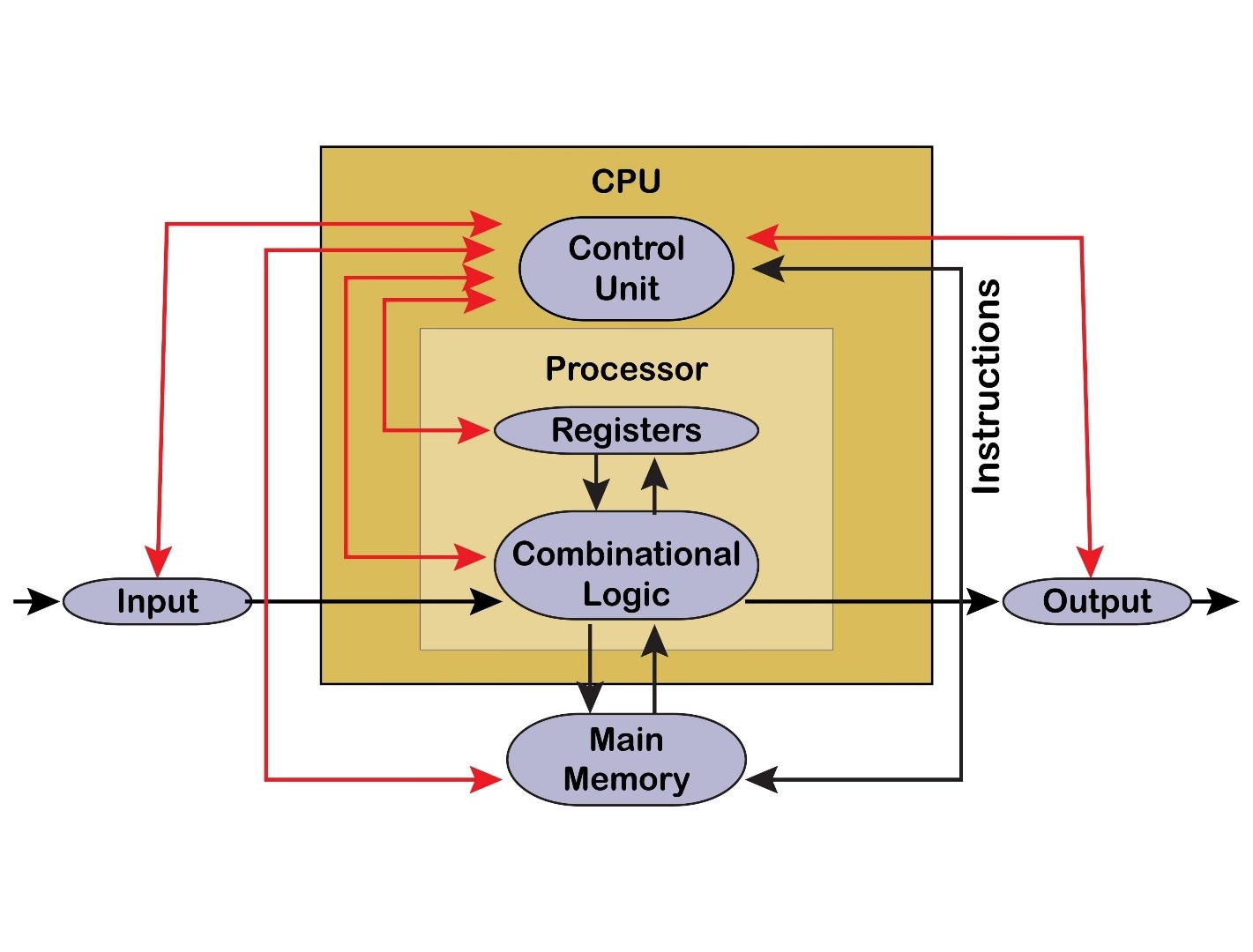
While a general-purpose computer is designed for computation-heavy tasks (like video editing or gaming), a microcontroller is control-focused. It reads data from sensors, processes it based on pre-written code, and sends signals to control hardware components. This self-contained design eliminates the need for external supporting chips, making it ideal for cost-sensitive and space-constrained applications.
Main Components of a Microcontroller
A microcontroller integrates several functional blocks onto a single chip to perform its tasks efficiently.
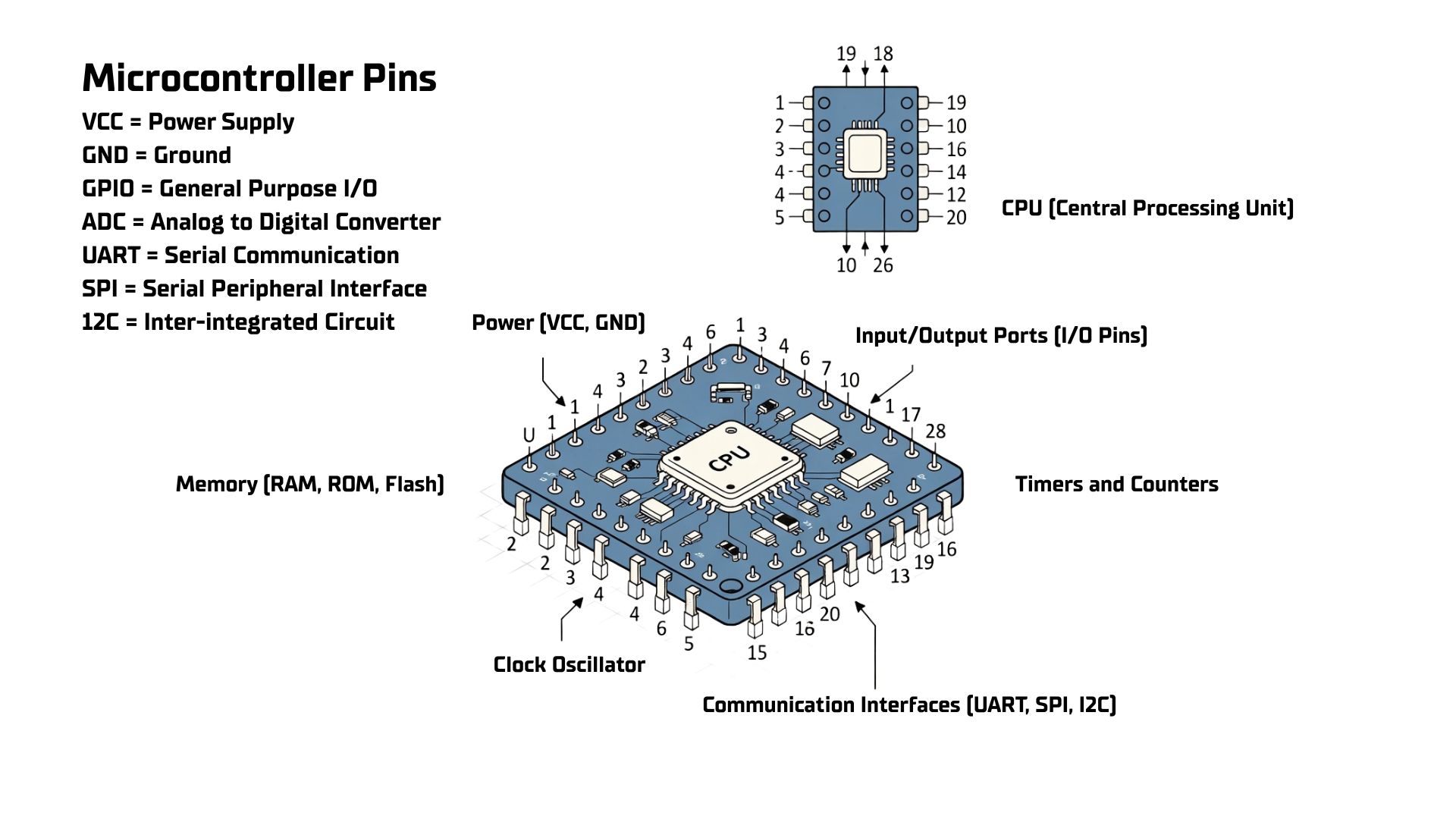
- CPU (Central Processing Unit): The “brain” of the device, responsible for fetching, decoding, and executing instructions from the program memory.
- Memory (RAM, ROM, Flash): This includes Flash/ROM for storing the permanent program code and RAM for storing temporary data variables while the device is running.
- Input/Output Ports (I/O Pins): These physical pins allow the microcontroller to interface with the outside world, connecting to sensors (inputs) and actuators like LEDs or motors (outputs).
- Timers and Counters: These internal modules are crucial for measuring time intervals, creating delays, or counting external events without occupying the CPU.
- Clock Oscillator: A quartz crystal or RC circuit that provides the timing heartbeat, synchronizing all internal operations and determining the speed of the processor.
- Communication Interfaces (UART, SPI, I2C): Specialized hardware blocks that allow the microcontroller to exchange data with other chips, computers, or sensors.
How Does a Microcontroller Work?
The operational cycle of a microcontroller is a continuous, programmed sequence designed to interact with its environment. First, a program written in a language like C or C++ is compiled and stored in the microcontroller’s non-volatile flash memory. When powered on, the CPU fetches instructions from this memory. It then reads incoming data from the physical world via its input ports, which are connected to components like temperature sensors or buttons. Following the program’s logic, the CPU processes this input data, making decisions and performing calculations. Finally, the microcontroller acts on the results by sending commands through its output ports to connected devices—for example, turning on a cooling fan, adjusting the brightness of an LED, or updating information on a screen. This “sense-process-actuate” loop runs repeatedly, enabling real-time control.
Types of Microcontrollers
Microcontrollers are categorized by their bus width (processing capacity) and architecture, which dictates their suitability for different tasks.
- 8-bit Microcontrollers: These process 8 bits of data at a time. They are simple, low-cost, and energy-efficient, making them perfect for basic tasks like remote controls.
- 16-bit Microcontrollers: Offering a balance between cost and performance, these are used in applications requiring higher precision than 8-bit chips, such as some automotive subsystems.
- 32-bit Microcontrollers: These are high-performance chips capable of handling complex computations and high speeds, often found in drones and advanced medical devices.
- 64-bit Microcontrollers: These are extremely rare and generally not used in typical embedded systems.
- Application-Specific Microcontrollers: Designed for a unique purpose, such as automotive engine control units (ECUs).
- General-Purpose Microcontrollers: Versatile chips like the Arduino’s AT mega series that can be programmed for a wide variety of hobbyist and commercial projects.
Popular Microcontroller Examples
There are thousands of microcontroller models available, but a few families have become industry standards due to their reliability and ease of use.
| Microcontroller | Manufacturer | Common Use |
| Arduino (ATmega) | Microchip (formerly Atmel) | Learning, prototyping, and DIY hobby projects. |
| PIC | Microchip | Industrial control systems and automotive applications. |
| 8051 | Intel (original) | Legacy embedded systems and education. |
| STM32 | STMicroelectronics | Advanced IoT, drones, and automation systems. |
| ESP32 | Espressif | Wi-Fi & Bluetooth connected smart home projects. |
Applications of Microcontrollers
Microcontrollers are ubiquitous in modern life, embedded invisibly into the fabric of our daily routines and industries.
- Home appliances: Washing machines, microwave ovens, and refrigerators rely on them to manage cycles and temperature.
- Automobiles: Modern cars contain dozens of MCUs controlling everything from anti-lock braking systems (ABS) to power windows and engine timing.
- Medical equipment: Portable glucose monitors, blood pressure cuffs, and diagnostic machines use them for precise measurements.
- Consumer electronics: Digital cameras, gaming controllers, and wearables like smartwatches are powered by efficient microcontrollers.
- Industrial automation: Robotics arms, conveyor belt controllers, and factory sensors utilize them for precise, repetitive tasks.
- IoT and smart devices: Smart bulbs, connected thermostats, and security cameras use MCUs (often with Wi-Fi) to communicate with the internet.
Microcontroller vs Microprocessor
While they sound similar, microcontrollers and microprocessors serve very different roles in electronics engineering. A microprocessor is a raw processing engine that needs external parts to function, whereas a microcontroller is an all-in-one system.
| Feature | Microcontroller | Microprocessor |
| Components | CPU + Memory + I/O all on one chip. | CPU only (requires external RAM, storage, I/O). |
| Cost | Generally low cost. | Higher cost due to complexity and external parts. |
| Power usage | Low power, often battery-friendly. | High power consumption. |
| Applications | Embedded systems (Microwaves, Remotes). | General computing (Laptops, Desktops, Servers). |
| External hardware | Minimal or none required. | Extensive external motherboard circuitry required. |
Advantages and Limitations of Microcontrollers
The design of microcontrollers involves trade-offs that make them perfect for some jobs but unsuitable for others.
Advantages:
- Low power consumption: Many can run on batteries for years.
- Compact size: Essential for portable devices.
- Cost-effective: Mass production makes them extremely cheap (often cents per unit).
- Reliable for dedicated tasks: They do one thing very reliably without crashing like a complex OS might.
Limitations:
- Limited processing power: Not suitable for heavy data crunching like video rendering.
- Memory constraints: Flash and RAM are usually limited to kilobytes or megabytes.
- Not suitable for heavy computation: They cannot run full desktop operating systems like Windows or macOS.
Conclusion
A microcontroller is the unsung hero of the digital age, acting as the dedicated brain for billions of devices. By integrating a processor, memory, and input/output capabilities into a single chip, it allows for the creation of smart, compact, and affordable electronics for beginners and hobbyists, learning to program a microcontroller opens the door to understanding how the modern world works, bridging the gap between software code and physical action.