
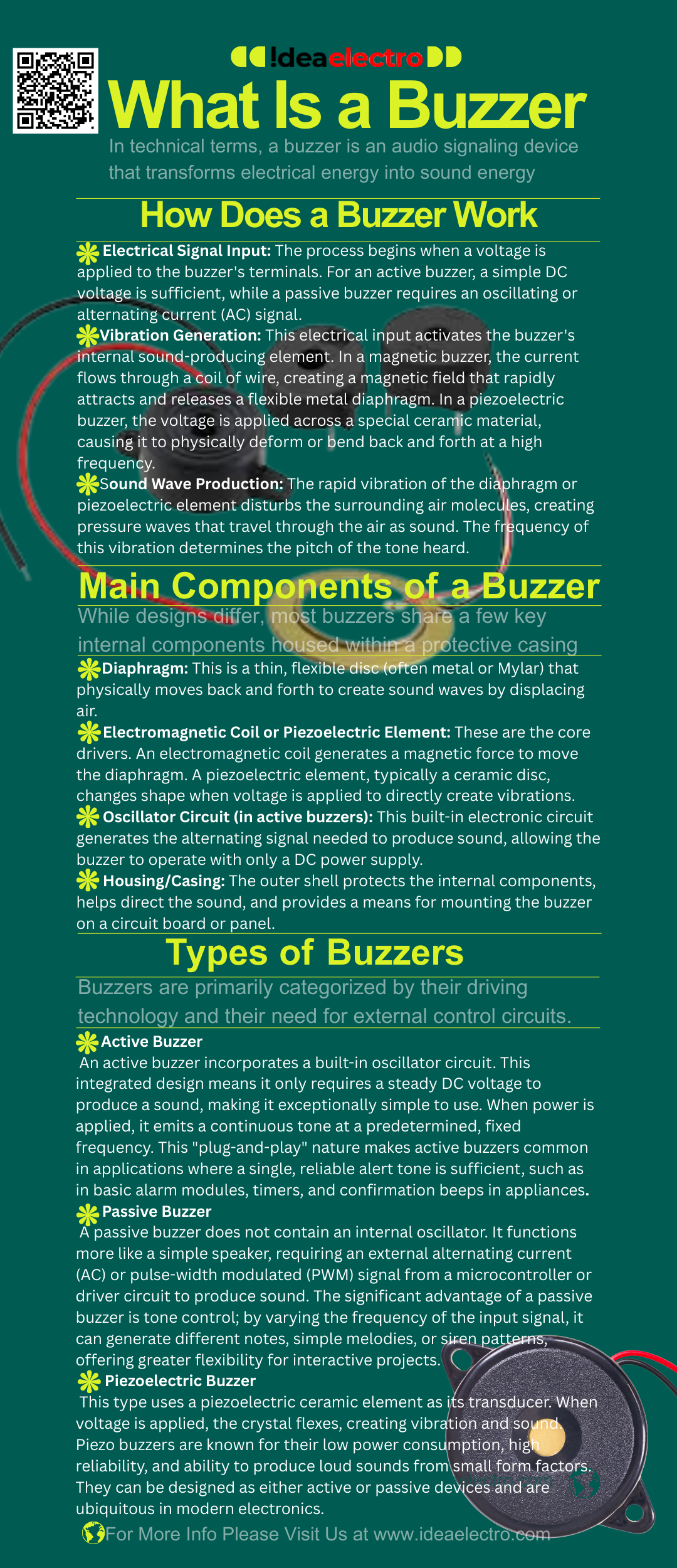
In technical terms, a buzzer is an audio signaling device that transforms electrical energy into sound energy. It operates as an output component in a circuit, where an applied electrical signal—either a direct current (DC) voltage or an alternating waveform—is used to generate audible sound waves. The core purpose of a buzzer is not to reproduce complex audio like music or speech with high fidelity, but rather to produce a distinct and attention-grabbing tone for alerting and signaling. This makes it an ideal component for warnings, confirmations, and status indications in countless electronic systems, from simple DIY projects to complex industrial machinery.
How Does a Buzzer Work?
The operation of a buzzer involves a straightforward process of electromechanical conversion. Although specific mechanisms vary between types, the fundamental steps are consistent.
- Electrical Signal Input: The process begins when a voltage is applied to the buzzer’s terminals. For an active buzzer, a simple DC voltage is sufficient, while a passive buzzer requires an oscillating or alternating current (AC) signal.
- Vibration Generation: This electrical input activates the buzzer’s internal sound-producing element. In a magnetic buzzer, the current flows through a coil of wire, creating a magnetic field that rapidly attracts and releases a flexible metal diaphragm. In a piezoelectric buzzer, the voltage is applied across a special ceramic material, causing it to physically deform or bend back and forth at a high frequency.
- Sound Wave Production: The rapid vibration of the diaphragm or piezoelectric element disturbs the surrounding air molecules, creating pressure waves that travel through the air as sound. The frequency of this vibration determines the pitch of the tone heard.
In essence, a buzzer’s operation can be mechanical, where a physical switch makes and breaks a circuit (as in some old-fashioned doorbells), or electronic, where solid-state components create the oscillation for a cleaner and more reliable tone.
Main Components of a Buzzer
While designs differ, most buzzers share a few key internal components housed within a protective casing:
- Diaphragm: This is a thin, flexible disc (often metal or Mylar) that physically moves back and forth to create sound waves by displacing air.
- Electromagnetic Coil or Piezoelectric Element: These are the core drivers. An electromagnetic coilgenerates a magnetic force to move the diaphragm. A piezoelectric element, typically a ceramic disc, changes shape when voltage is applied to directly create vibrations.
- Oscillator Circuit (in active buzzers): This built-in electronic circuit generates the alternating signal needed to produce sound, allowing the buzzer to operate with only a DC power supply.
- Housing/Casing: The outer shell protects the internal components, helps direct the sound, and provides a means for mounting the buzzer on a circuit board or panel.
Types of Buzzers
Buzzers are primarily categorized by their driving technology and their need for external control circuits.
- a) Active Buzzer
An active buzzer incorporates a built-in oscillator circuit. This integrated design means it only requires a steady DC voltage to produce a sound, making it exceptionally simple to use. When power is applied, it emits a continuous tone at a predetermined, fixed frequency. This “plug-and-play” nature makes active buzzers common in applications where a single, reliable alert tone is sufficient, such as in basic alarm modules, timers, and confirmation beeps in appliances. - b) Passive Buzzer
A passive buzzer does not contain an internal oscillator. It functions more like a simple speaker, requiring an external alternating current (AC) or pulse-width modulated (PWM) signal from a microcontroller or driver circuit to produce sound. The significant advantage of a passive buzzer is tone control; by varying the frequency of the input signal, it can generate different notes, simple melodies, or siren patterns, offering greater flexibility for interactive projects. - c) Piezoelectric Buzzer
This type uses a piezoelectric ceramic elementas its transducer. When voltage is applied, the crystal flexes, creating vibration and sound. Piezo buzzers are known for their low power consumption, high reliability, and ability to produce loud sounds from small form factors. They can be designed as either active or passive devices and are ubiquitous in modern electronics. - d) Electromagnetic/Magnetic Buzzer
These buzzers operate on the principle of electromagnetism. A current passing through a coil generates a magnetic field that interacts with a magnetic diaphragm, causing it to vibrate. They typically operate at lower voltages and can offer a different sonic character compared to piezo buzzers, often being used in applications where a specific sound profile is desired.
Active Buzzer vs Passive Buzzer
The choice between an active and passive buzzer is fundamental and depends on the needs of the project. The following table summarizes their key differences:
| Feature | Active Buzzer | Passive Buzzer |
| Power Requirement | DC voltage (has internal oscillator) | External AC/oscillating signal (no internal oscillator) |
| Sound & Tone Control | Fixed, single frequency | Variable; can produce different tones and melodies |
| Circuit & Control Complexity | Simple; controlled like an LED (on/off) | More complex; requires a timer or microcontroller to generate a signal |
| Common Use Case | Simple alarms, status indicators, timers | Musical notes, multi-tone alerts, interactive projects |
Common Applications of a Buzzer
Due to their reliability and cost-effectiveness, buzzers are employed in a vast array of fields to provide essential audible feedback:
- Alarm and Security Systems: Fire alarms, smoke detectors, burglar alarms, and security system panels.
- Home Appliances: Timers on microwaves and ovens, cycle completion alerts on washing machines, and refrigerator door-ajar warnings.
- Industrial Machinery: Warning signals for machine startup, fault conditions, process completion, and safety interlocks.
- Automotive Electronics: Seatbelt reminders, key-in-ignition alerts, and parking sensor warnings.
- Consumer Electronics: Button-press confirmation on devices, low-battery alerts, and notification tones.
- Medical Equipment: Patient monitors and infusion pumps that alert staff to changes in status.
Advantages of Using a Buzzer
- Low Power Consumption: Especially piezoelectric types, which draw very little current (often under 15mA).
- Simple Integration: Active buzzers, in particular, are easy to wire into a circuit, requiring minimal additional components.
- Compact Size: Available in very small packages, making them suitable for space-constrained modern electronics.
- Cost-Effective: They are inexpensive to manufacture and purchase, providing high value for a simple alert function.
- High Reliability: With no complex moving parts (especially piezo types), they offer long operational lifespans.
Limitations of a Buzzer
Despite their utility, buzzers have inherent limitations. Their sound range is limited, typically producing a single tone or a narrow band of frequencies, which makes them unsuitable for high-fidelity music or voice reproduction. Furthermore, while they can be made loud, their volume and audio output power are constrained by their small size and design. This can make them difficult to hear in very noisy industrial environments without careful selection of a model with a high sound pressure level (SPL).
Buzzer vs Speaker
It is important to distinguish buzzers from speakers, as they serve different purposes. A speaker is designed to accurately reproduce a wide range of audio frequencies, enabling high-quality music and speech. A buzzer is engineered to produce a clear, attention-grabbing tone efficiently. The table below highlights the core differences:
| Aspect | Buzzer | Speaker |
| Primary Function | Audible alert and signaling | Broad-spectrum audio reproduction |
| Sound Quality & Range | Limited frequency range; monotone or simple tones | Wide frequency range for complex sounds |
| Typical Usage | Alarms, beeps, status indicators | Music, voice, sound effects |
| Circuit Complexity | Generally simple, especially for active types | Often requires a dedicated amplifier circuit |
| Power Consumption | Typically low | Can be high, depending on output volume |
How to Choose the Right Buzzer
Selecting the appropriate buzzer for a project involves considering several key specifications:
- Operating Voltage: Ensure the buzzer’s rated voltage (e.g., 3V, 5V, 12V) matches your circuit’s power supply.
- Current Consumption: Verify that your power source or driving pin (e.g., on a microcontroller) can supply the required current, which is higher for magnetic types.
- Sound Pressure Level (SPL): Measured in decibels (dB), this indicates loudness. Choose a higher dB rating for noisy environments.
- Type (Active/Passive): Decide based on whether you need a simple beep (active) or tonal variety (passive).
- Mounting Style: Consider whether you need through-hole pins for a circuit board or a panel-mount casing with screw terminals.
- Size and Profile: The physical dimensions must fit within the available space in your device’s enclosure.
Conclusion
In summary, a buzzer is a versatile and essential electronic component that provides a simple, effective method for audible signaling. From its basic function of converting electrical energy into sound to its various implementations as active, passive, piezoelectric, or electromagnetic devices, the buzzer solves a fundamental problem in human-machine interaction. Its advantages of low cost, reliability, and ease of use cement its place in everything from household gadgets to critical safety systems. When integrating a buzzer into a design, careful consideration of its type, specifications, and intended application is key to achieving an effective and reliable alert mechanism. For those interested in electronics, understanding the humble buzzer is an excellent step toward mastering more complex audio and feedback systems in circuit design.