The Language of Modern Technology:
Every interaction with your smartphone, laptop, or tablet relies on a fundamental shift in how we process information. While the natural world—the sound of a voice, the gradient of a sunset, or the heat of a room—exists in a continuous, “infinite” flow of data, our devices cannot process such vast, unbroken streams efficiently. Instead, they rely on digital signals, which are discrete, quantized representations of information. Unlike analog signals that vary smoothly over time, a digital signal breaks data into distinct, manageable “steps” or values. This allows for the high-speed processing and storage that define the modern computing era.
The Core Definition: Bits and Binary
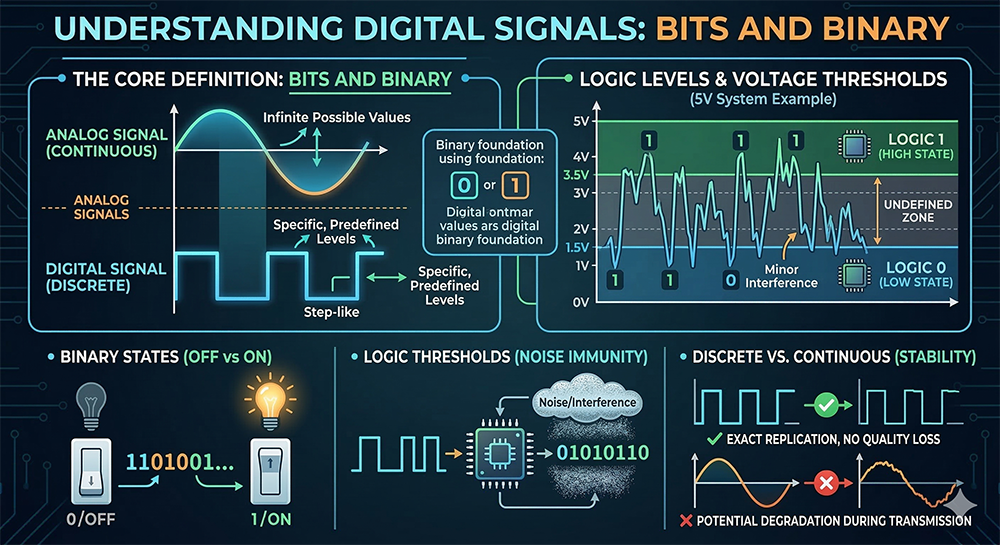
At its most fundamental level, a digital signal is non-continuous; it does not exist at every possible value but rather at specific, predefined levels. This system is built upon the binary foundation, the simplest form of data representation using only two states: 0 and 1. In the world of electrical engineering, these numerical values correspond to physical “logic levels” or voltage thresholds. For instance, in a typical 5V system, a “High” state (1) might be represented by any voltage between 3.5V and 5V, while a “Low” state (0) is represented by 0V to 1.5V. This “step-like” nature is what distinguishes digital data, ensuring that information is clear, concise, and easily interpreted by a processor without the ambiguity of slight fluctuations.
- Binary States: Information is encoded as “Off” (0) or “On” (1), forming the “bits” that serve as the building blocks of all digital files.
- Logic Thresholds: Discrete voltage levels ensure that even if a signal experiences minor interference, the hardware can still correctly identify it as a 0 or a 1.
- Discrete vs. Continuous: Because digital signals move in steps, they provide a stable framework for data that can be copied and transmitted without losing original quality.
Analog vs. Digital: The Key Differences
Understanding digital signals requires a direct comparison to their predecessor: the analog signal. Analog signals are continuous waves that represent physical measurements. While they are a direct “analogue” of the real world, they are incredibly sensitive to noise—any slight electrical interference can permanently distort the original sound or image. In contrast, digital signals are highly resilient. Because they only care about whether a signal is “high” or “low,” they can ignore the “fuzz” of background noise that would ruin an analog broadcast. This inherent durability is why the global infrastructure has shifted almost entirely to digital formats.
| Feature | Analog Signal | Digital Signal |
| Waveform Shape | Continuous sine waves | Discrete square waves |
| Noise Sensitivity | High; easily distorted by interference | Low; highly resistant to noise |
| Storage Efficiency | Low; requires physical media (tapes/vinyl) | High; can be compressed and stored in tiny flash drives |
| Bandwidth | Consumes more bandwidth for less data | Uses bandwidth efficiently through compression |
The transition from analog to digital was driven primarily by the need for error correction and data compression. In an analog system, once noise is added to a signal, it cannot be removed. However, digital systems use mathematical algorithms to check for errors and “rebuild” the signal at its destination, ensuring perfect reproducibility every time.
How Digital Signals are Created: Sampling and Quantization
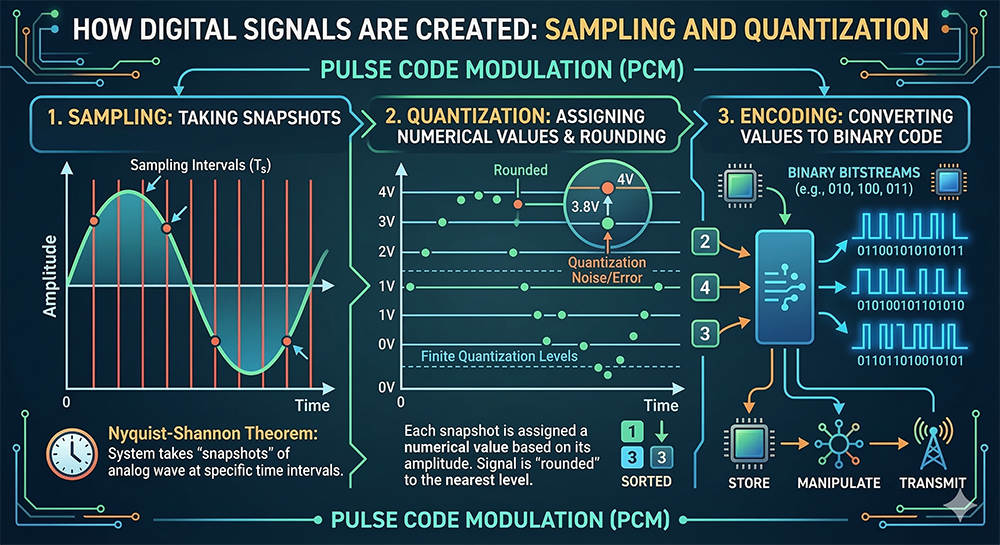
Since the world we live in is analog, we must convert those continuous waves into digital bits using a process known as Pulse Code Modulation (PCM). This bridge between the physical and digital worlds involves three critical steps:
- Sampling: The system takes “snapshots” of an analog wave at specific time intervals. According to the Nyquist-Shannon sampling theorem, the sampling rate must be at least twice the highest frequency of the signal to capture it accurately.
- Quantization: Each of these snapshots is assigned a numerical value based on its amplitude. Because there are a finite number of values available, the signal is “rounded” to the nearest level.
- Encoding: These numerical values are then converted into a string of binary code (0s and 1s), which a computer can then store, manipulate, or transmit.
Advantages and Limitations
Digital signaling has revolutionized society, but it is not without its trade-offs. The primary strength of digital signals lies in their reliability.
The Pros:
- Immunity to Noise: Digital systems can distinguish between signal and interference far better than analog systems.
- Easy Encryption: Because data is just a series of numbers, it can be mathematically “scrambled” for secure communication.
- Perfect Reproducibility: A digital file can be copied a billion times without the slightest degradation in quality.
The Cons:
- Quantization Error: The process of “rounding” values during quantization can lead to a slight loss of fine detail, known as quantization noise.
- Hardware Demands: Processing millions of bits per second requires high-speed processors and sophisticated Analog-to-Digital Converters (ADCs).
Real-World Applications
Digital signals are the invisible threads connecting almost every piece of modern technology. In telecommunications, Voice over IP (VoIP) and 5G networks convert our voices into packets of digital data, allowing for crystal-clear calls across the globe. In consumer electronics, HDMI cables transmit uncompressed digital video and audio to our screens, ensuring that the colors and sounds we see are exactly what the creator intended.
- Telecommunications: 5G and fiber-optic networks rely on ultra-fast digital switching to move massive amounts of data.
- Medical Imaging: Technologies like MRI and digital X-rays use digital sensors to create high-resolution images that can be enhanced and shared instantly by doctors.
- Automotive: Modern Electric Vehicles (EVs) use digital signals to manage battery efficiency and autonomous driving sensors.
Conclusion: The Future of Digital Signaling
As we move deeper into an AI-driven world, the importance of digital signaling only grows. While the universe remains inherently analog, our ability to study, simulate, and interact with it depends entirely on the precision of the digital “language.” From the binary code powering neural networks to the high-speed signals inside quantum computers, the discrete “step” of the digital signal remains the most powerful tool in the history of human engineering.