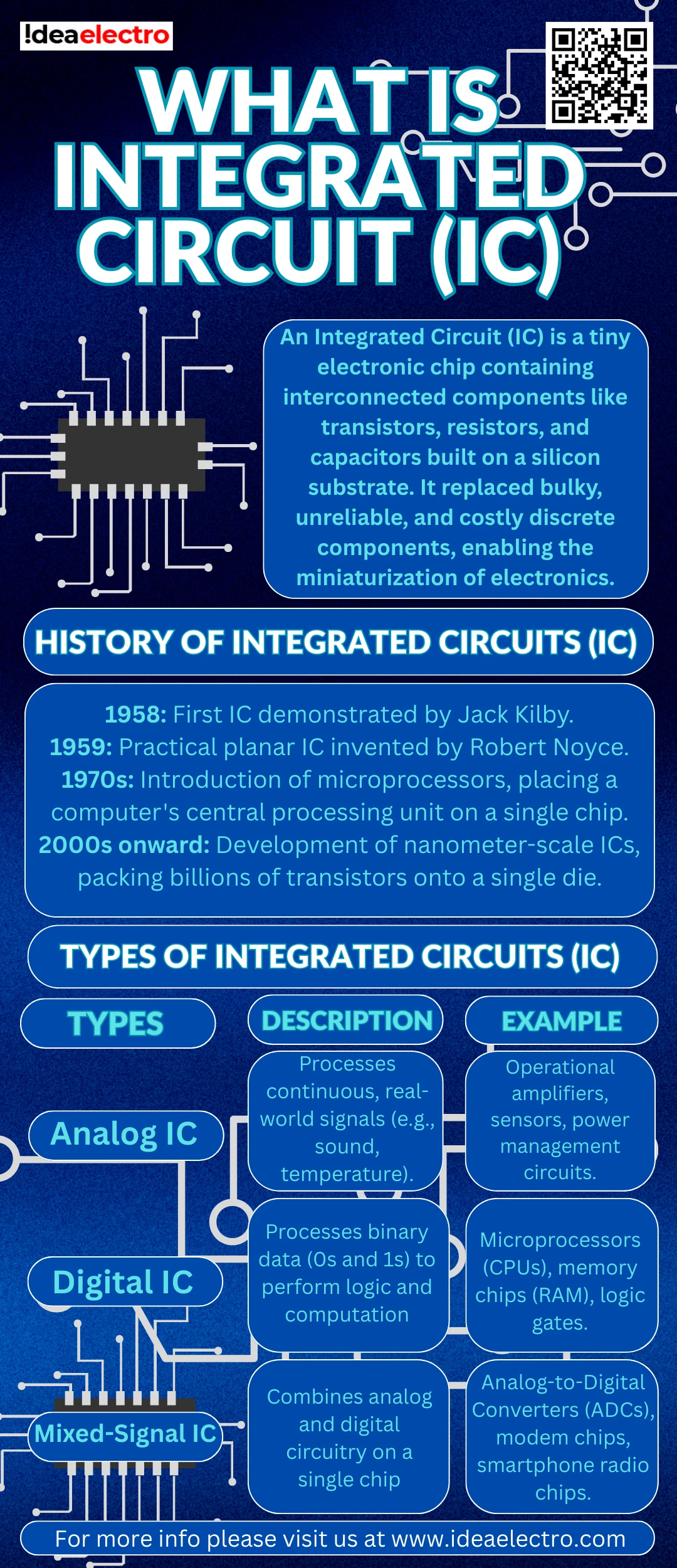
An Integrated Circuit (IC) is a tiny electronic chip containing interconnected components like transistors, resistors, and capacitors built on a silicon substrate. It replaced bulky, unreliable, and costly discrete components, enabling the miniaturization of electronics. ICs transformed room-sized systems into pocket-sized devices. Today, they are essential to modern technology, offering high performance, energy efficiency, and low cost while powering almost every digital device we use in daily life.
History of Integrated Circuits
- The integrated circuit emerged to solve the mid-20th-century “tyranny of numbers,” where assembling thousands of components became impractical. Jack Kilby created the first IC in 1958, and Robert Noyce introduced the planar silicon IC in 1959, enabling mass production and launching modern semiconductor technology’s rapid scaling.1958:First IC demonstrated by Jack Kilby.
- 1959:Practical planar IC invented by Robert Noyce.
- 1970s:Introduction of microprocessors, placing a computer’s central processing unit on a single chip.
- 2000s onward:Development of nanometer-scale ICs, packing billions of transistors onto a single die.
What Exactly Is an Integrated Circuit?
Technically, an integrated circuit is a miniaturized electronic circuit fabricated on a thin substrate of semiconductor material, almost exclusively silicon. Through sophisticated manufacturing processes, areas of the silicon are modified—”doped” with specific impurities—to create fundamental components like transistors, which act as microscopic switches. Alongside these, resistors to control current and capacitors to store charge are formed. These components are then connected by a network of incredibly fine metal interconnects, often just atoms wide, layered above the silicon.
This monolithic construction is what differentiates an IC from a circuit built with discrete components. Instead of soldering separate parts onto a board, all elements are inseparably fused into a single, unified piece of silicon. This integration yields transformative advantages:
- Miniaturization:Millions to billions of components are condensed onto a chip sometimes smaller than a human fingernail.
- Low Power Consumption:The extremely small size of transistors and short interconnects reduce the energy required for operation, which is critical for battery-powered devices.
- High Speed:Electrical signals have very short distances to travel between components, enabling extremely fast processing and signal switching.
- High Reliability:With far fewer external solder joints and connections that can fail, ICs are significantly more reliable and durable than discrete assemblies.
Types of Integrated Circuits
Integrated circuits are categorized in two primary ways: by the type of signals they process and by their scale of integration. Based on signal processing, the three main types are analog, digital, and mixed-signal ICs, each serving distinct roles in electronic systems.
Table: Primary Types of Integrated Circuits by Function
| Type | Description | Common Examples |
| Analog IC | Processes continuous, real-world signals (e.g., sound, temperature). | Operational amplifiers, sensors, power management circuits. |
| Digital IC | Processes binary data (0s and 1s) to perform logic and computation. | Microprocessors (CPUs), memory chips (RAM), logic gates. |
| Mixed-Signal IC | Combines analog and digital circuitry on a single chip. | Analog-to-Digital Converters (ADCs), modem chips, smartphone radio chips. |
Based on the number of gates or transistors packed onto a single chip, a historical classification known as integration scale is used. This scale reflects the exponential growth in complexity over decades:
- SSI (Small-Scale Integration):Dozens of transistors (early logic gates).
- MSI (Medium-Scale Integration):Hundreds of transistors.
- LSI (Large-Scale Integration):Thousands of transistors (early microprocessors).
- VLSI (Very Large-Scale Integration):Hundreds of thousands to millions of transistors.
- ULSI (Ultra-Large-Scale Integration):Billions of transistors, representing modern processors and memory chips.
Common IC Packages and How They Look
After fabrication, the delicate silicon die must be packaged to protect it from physical damage and environmental factors and to provide a way to connect it to a printed circuit board (PCB). The package is the black plastic or ceramic casing with metallic leads or bumps that we typically see on a circuit board.
Packages vary greatly in size, shape, and mounting style. Through-hole packages have long leads designed to be inserted into holes on a PCB and soldered on the opposite side. In contrast, Surface-Mount Device (SMD) packages are designed to sit directly on and be soldered to the surface of a PCB, allowing for much higher component density. Common package types include:
- DIP (Dual In-line Package):A classic through-hole package with two parallel rows of pins.
- SOP/SOIC (Small Outline Package/IC):A common surface-mount version of the DIP, with gull-wing shaped leads.
- QFP (Quad Flat Package):A square, surface-mount package with pins on all four sides, allowing for high pin counts.
- BGA (Ball Grid Array):A advanced surface-mount package where connections are made via an array of tiny solder balls on its underside, enabling very high density and better electrical performance.
Applications of Integrated Circuits in Real Life
Integrated circuits are the invisible engines of the modern technological landscape, finding applications in virtually every industry. Their ability to process information, manage power, and control systems has enabled revolutionary advancements across sectors.
In consumer electronics, ICs are the heart of every smart device. A single smartphone contains dozens of chips: a powerful microprocessor for computing, memory chips for storage, dedicated graphics and AI processors, and power management ICs to efficiently run the battery. Televisions, gaming consoles, and smart home devices all similarly rely on a suite of specialized ICs for their core functions. Beyond consumer tech, ICs are critical in medical devices such as ECG machines, MRI scanners, and portable monitors, where they enable precise measurement, signal processing, and data analysis. The automotive industry has become deeply dependent on ICs, with modern vehicles containing over a hundred chips that manage everything from engine control and fuel efficiency to advanced driver-assistance systems (ADAS), airbag deployment, and in-car entertainment. Furthermore, the global communication infrastructure—from cellular routers and satellites to fiber-optic networks—is built upon high-speed analog, digital, and mixed-signal ICs that transmit, receive, and process vast streams of data.
Table: some example ICs in Everyday Devices
| Device | IC Used For |
| Smartphone | Central processing (CPU), graphics (GPU), wireless communication, power management, sensor data fusion. |
| Car | Engine control unit (ECU), anti-lock braking systems (ABS), infotainment, radar/LiDAR sensors for ADAS. |
| Television | Video decoding and processing, audio amplification, display driver control, smart TV operating system. |
computers rely on complex microprocessors and memory chips
Home appliances, from microwaves to washing machines, use ICs for control and functionality.
Advantages of Integrated Circuits
The widespread adoption of integrated circuits is driven by a compelling set of advantages over circuits built from discrete components. These benefits are interconnected and have collectively fueled the digital revolution:
- Compact Size and Light Weight:The extreme miniaturization of components allows for incredibly small and portable electronic devices.
- Low Cost:While the initial fabrication facility is astronomically expensive, the ability to mass-produce thousands of identical chips on a single silicon wafer makes the cost per individual IC very low.
- Low Power Consumption:The small size of transistors and short interconnects reduce capacitance and resistance, requiring less energy to switch states, which is essential for mobile and battery-operated devices.
- High Reliability:With fewer external solder joints and interconnections that can corrode or break, and with all components fabricated in a controlled environment, ICs offer superior long-term reliability.
- High Performance and Speed:The proximity of components on a chip allows for very fast switching speeds and high-frequency operation, enabling powerful computing capabilities.
Limitations of Integrated Circuits
Despite their transformative benefits, integrated circuits are not a universal solution for all electronic needs and come with inherent limitations:
- Power Handling:ICs are generally not suitable for very high-power applications (like industrial motor control or power grid transmission) because the concentrated heat generated can destroy the tiny transistors. Discrete components are still used for these tasks.
- Component Limitations:It is difficult and inefficient to fabricate certain passive components, particularly large-value inductors and capacitors, directly on a silicon chip at a practical size. These are often added externally as discrete parts.
- Repair and Modification:Once manufactured, the internal circuitry of an IC is fixed and inaccessible. If a single transistor fails, the entire chip must be replaced, as internal repairs are impossible.
- Design and Manufacturing Complexity:The design of a modern IC requires immense expertise and expensive software tools. The manufacturing process itself is arguably the most complex in the world, requiring multi-billion-dollar facilities.
Future of Integrated Circuits
The future of integrated circuits is being shaped by the need to move beyond traditional scaling. While transistors continue to shrink—with 2-nanometer (nm) and 1.8nm processes entering production—engineers are now focusing on architectural innovations and new computing paradigms to sustain progress.
Specialized and Brain-Inspired Processors
The demand for artificial intelligence is driving the development of specialized AI accelerators like GPUs, TPUs, and custom ASICs that are far more efficient at matrix math than general-purpose CPUs. Parallel to this is the advancement of neuromorphic computing, which designs chips inspired by the human brain’s structure. These chips use spiking neural networks (SNNs) and event-driven processing to achieve orders-of-magnitude gains in energy efficiency for tasks like real-time sensory processing. Furthermore, quantum processors represent a fundamental shift, leveraging quantum bits (qubits) to solve certain classes of problems intractable for classical computers, with rapid progress being made in error correction and commercial viability.
Sustainable and Flexible Electronics
Finally, research is exploring new frontiers like flexible electronics, where circuits are fabricated on bendable substrates using novel materials such as liquid metal composites. This promises not only new form factors for wearable devices but also pathways to more recyclable and sustainable electronics, addressing the growing problem of e-waste.
Conclusion
In summary, the integrated circuit is a foundational technology that has reshaped society. From its origins in the late 1950s, the IC has evolved from a few transistors on a chip to systems containing billions, driving the relentless pace of digital innovation. By integrating microscopic components onto a single piece of silicon, ICs deliver unparalleled miniaturization, reliability, and performance at low cost, powering everything from everyday appliances to global communications networks. As the industry pushes the boundaries of physics with atomic-scale transistors and embraces revolutionary architectures like 3D stacking and neuromorphic design, the integrated circuit will continue to be the central engine of technological progress, enabling future breakthroughs in computing, artificial intelligence, and beyond.